Deacs who ran Student Government have a powerful advantage when they land in the nation’s capital — the leadership lessons they learned at Wake Forest.
By Kelly Greene (’91)
Photography by Nick Fantasia

ASHINGTON, D.C. — Natalie Halpern Hales (’11) fondly remembers the office she enjoyed as Student Government president: The window framing magnolias in bloom. The expansive space for cabinet meetings or studying when the library got crowded.
Then she graduated and moved to Washington, trading her presidential digs for a windowless cubicle. “Wow. Maybe I peaked when I was 22,” she remembers thinking during her stint as an assistant for a political action committee.
Danny Reeves (’19) was thrilled to address the thousands of graduates, friends and family members assembled on the Quad for Commencement — then watched his business-major friends starting six-figure jobs while he scraped to land a “barely paid internship” in the House of Representatives.
But Hales and Reeves discovered during Capitol Hill job interviews the one thing that set them apart in the sea of political science majors. “Being a Student Government president was actually unique,” Hales says, “a small club across the country of people who can say, ‘My peers elected me to do this job.’”
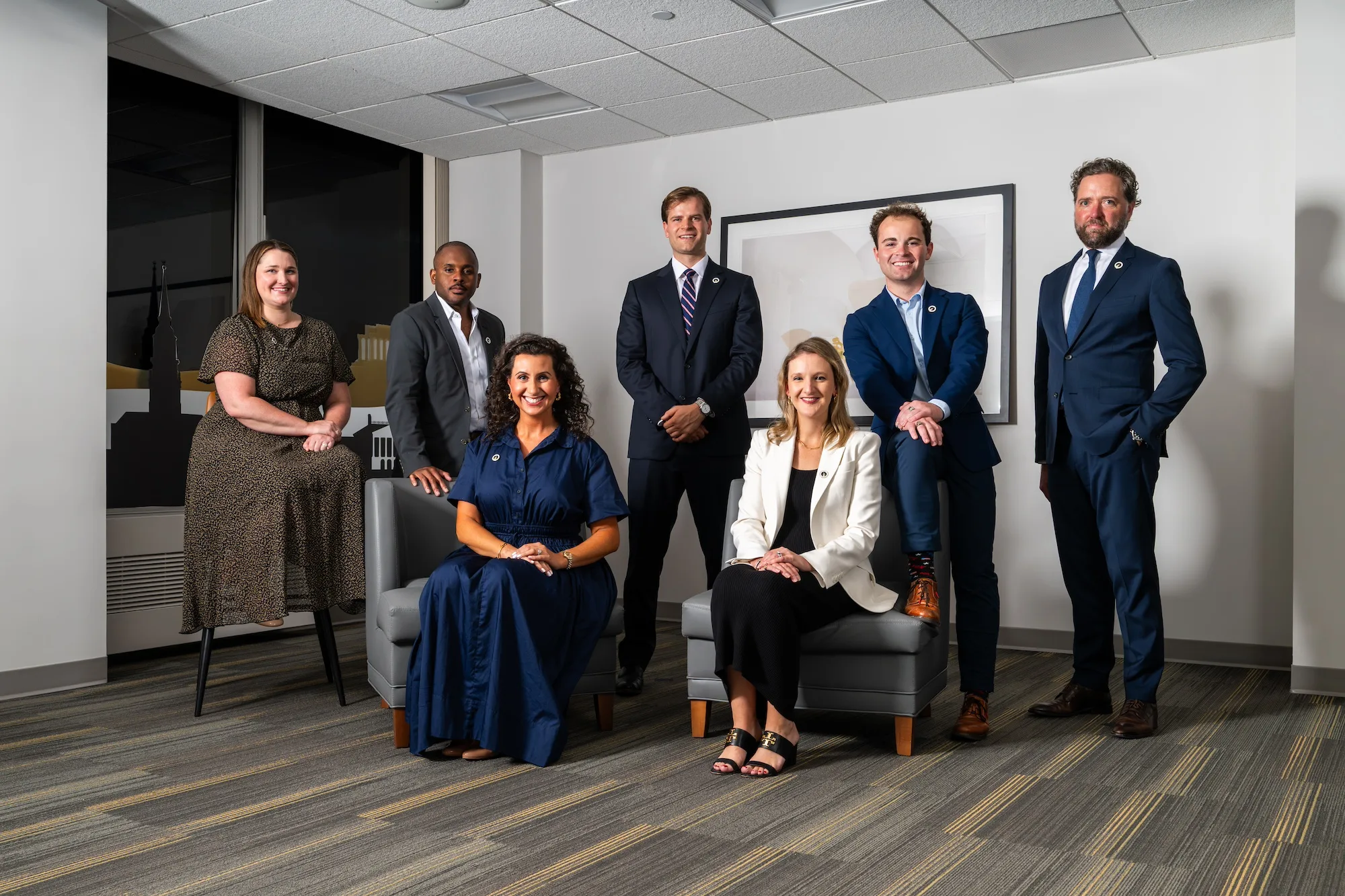
They are two of at least a dozen former Wake Forest Student Government presidents who emerged from their terms so smitten with politics and public service that they went on to careers in the nation’s capital.
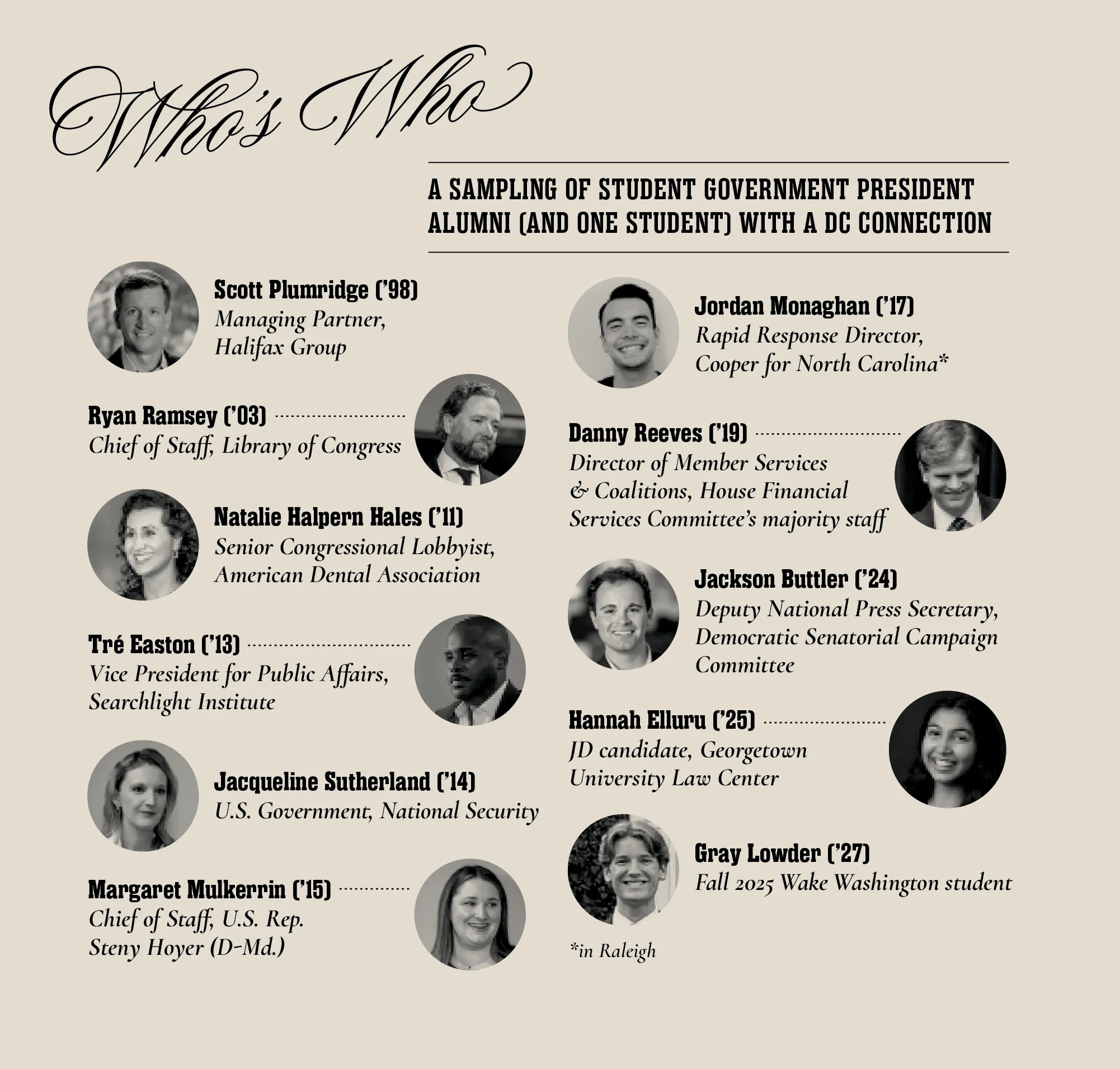
Spoiler alert: None of them peaked at 22. Hales worked for two members of Congress before becoming a lobbyist for the American Dental Association, where she now leads the congressional affairs team. Reeves played a key role in the negotiations and passage of July’s historic housing bill. Other presidential alumni now run congressional offices, proselytize think-tank research, put out campaign fires and shepherd the work of the Library of Congress.
They rely on the leadership lessons gained in Benson University Center, the epicenter of Student Government. And they uniformly describe their year in office as simultaneously challenging, isolating and wonderful. It was also instructive, and they still apply what they learned about leadership during their terms. Here are some of those lessons:
Reeves chose Wake Forest as his “dream school” in 10th grade even though he considered it a stretch, crediting his acceptance to the test-optional policy. Once on campus, he expected to focus full-time on his classes, scaling back the leadership posts he’d enjoyed in high school.
Instead, an information session for Student Government drew him in, and Reeves ran for a first-year Senate seat and won. As SG secretary his sophomore year, Reeves was surprised to see how much time President Jordan Monaghan (’17) spent nurturing relationships. “Even though you think of leadership as the big speeches,” Reeves says, “it’s how you treat people every day and that the relationships you make are authentic and true.”
Those relationship-building skills are “something I use every day” as member services and coalitions director for the House Financial Services Committee’s majority staff, he adds. “It’s vote-counting and relationships, and also knowing, like at Wake Forest, who cares about what.”
Last summer, Reeves negotiated the text for portions of the 21st Century Road to Housing Act, widely considered the most significant housing legislation enacted in decades. “When there’s an issue with a bill, I need to be able to call someone and have a very honest conversation about where we are and where we’re trying to go,” he says. “If you don’t have an authentic relationship, especially in a town like Washington where it’s so give-and-take, it’s going to be hard to get the result you want.”
Monaghan remembers watching then-SG President Jacqueline Sutherland (’14) model the office as a “cool opportunity to make Wake Forest a better place for everybody.” It made him want to follow in her footsteps, he says. “I still believe that politics is the best way to do the most good.”
The 2016 U.S. presidential election happened during his tenure, with some students rolling the Quad in celebration, and others writing anti-Trump messages in sidewalk chalk. He realized that “leadership is about helping to create the space where people can have conversations about tough issues.” Monaghan continued that approach through his work on campaigns in Maine and Michigan and then on the communications team of former Gov. Roy Cooper, North Carolina’s Democratic candidate for Senate.
Monaghan watched how politicians he worked for gathered decision-makers across divides to solve thorny problems, for example, bringing together “Republican county commissioners and sheriffs and people who were struggling and not able to afford their medications,” he says. “The power of convening was something I learned as Student Government president, and I have seen have lasting power and impact through my time on campaigns and particularly in [Cooper’s] office.”
During Scott Plumridge’s (’98) term as SG president, the on-campus judicial system, run back then by students, “had degraded” so badly that students were in danger of having it “stripped away,” he says. “We had to bring together administrators, teachers and students to figure out a path forward. It was a very thorny issue.”
He describes his role back then as bringing “different parties together and finding a suitable common ground for everybody.”
Now, Plumridge is a managing partner of Halifax Group, a private equity firm whose founders include David W. Dupree (MBA ’78, P ’20, ’22) and that works with middle-market businesses across industries. Helping different parties agree is “very much what I do professionally as well,” Plumridge says. “We find an opportunity we want to be involved with and invest our money behind, but we have to convince somebody … that it’s a good idea for them as well. And so, it’s give and take on both sides to find that appropriate middle-ground meeting point to make something actually happen.”
Jacqueline Sutherland (’14) was inspired to run for SG president after spending a semester in Istanbul. She started her campaign with the goal of expanding the University’s global offerings, but she soon shifted to what she saw as a bigger leadership challenge: “There were these independent pockets on campus of the student athletes, who need something a little different from students in Greek life, whose needs are different from international students,” she says. “I was thinking about ways to hear all those different individual thoughts and concerns and then be able to speak to them.”
Her platform, “Together for Wake,” sparked her “Talk to Me” initiative, for which she recruited a team to host conversations where diverse groups of students could connect openly and honestly. The questions were simple: What drew you to Wake Forest? What makes you you? The answers were heavy: How they were navigating racism, sexual abuse, discrimination in class as athletes and more, Sutherland says. The campaign continued at least a few years beyond her presidency, and she was delighted to spot its buttons and banners on return trips to campus.
Sutherland has followed the same blueprint, developing action plans and empowering teams, in increasingly critical roles in Washington. In 2017, following a master’s degree focused on political Islam at the London School of Economics and two years at a security and risk management advisory firm in Washington, she went to work for the federal government as a national security expert, specializing in the Middle East and state sponsors of terrorism. That included a one-year stint as the president’s daily briefer for the Biden administration, arriving at the office by 2 a.m. to develop “the book, … sort of like a classified newspaper for senior White House officials in the West Wing — the deputy national security adviser, the White House Homeland Security adviser and others,” she says. “I still remember mornings, just walking through the Rose Garden at 7 a.m. by myself to drop off the book for President Biden.”
That role led to more leadership roles in national security. The people-first philosophy she developed through “Together for Wake” still guides her today, she says. “I want to advocate for my officers and then empower them, so they know I have their backs, their best interests at heart. And I hope that enables them to do their very best work for the mission.”

Sutherland handed the gavel to Margaret Mulkerrin (’15), who says her biggest discovery about leadership was that it needs to start with listening. It began when someone really heard her: As a freshman, she felt so adrift as a New Englander that she was weighing a transfer to a school in Washington, D.C., figuring she could start interning and networking there. Through her tears, Mulkerrin confessed to then-SG Secretary Tré Easton (’13): “I don’t think this is the place for me. It doesn’t feel right.”
Easton acknowledged how she felt, and pointed out her choice: She could transfer — or she could choose to “try to make this a university where someone like you would want to stay,” Mulkerrin recalls.
That clicked. She doubled down on Wake Forest, got more involved in Student Government and ultimately ran for president. Active listening — “making sure that people feel heard” — was her go-to strategy during her term, which saw a steep rise in student activism over the treatment of students of color.
In Washington, Mulkerrin got her start as a confidential assistant in the Department of the Treasury, a job she landed while crashing on Easton’s couch between interviews. Fast-forward to her current role as chief of staff for longtime U.S. Rep. Steny Hoyer, D-Md., managing a team of nearly two dozen staffers, in which Mulkerrin continues to focus on listening first, she says. “So much of what people want is to feel validated, to feel heard, to feel like they have a place to take their concerns.”
Easton, after his year as SG president, headed straight to Washington and landed his first government job in the Department of Energy with help from an earlier SG president, Ryan Ramsey (’03). Easton worked on Capitol Hill as a deputy chief of staff and legislative director and is now vice president for public affairs at a think tank.
Like Mulkerrin, Easton has spent his career focused on listening, in his case to understand what he calls the “politics of the situation” — learning why people are angry or stuck and then focusing on how to solve the problem. At the Department of Energy, for example, “it’s not a partisan thing. People don’t care if it’s Republicans or Democrats cleaning up nuclear waste. They just want that to be taken care of.”
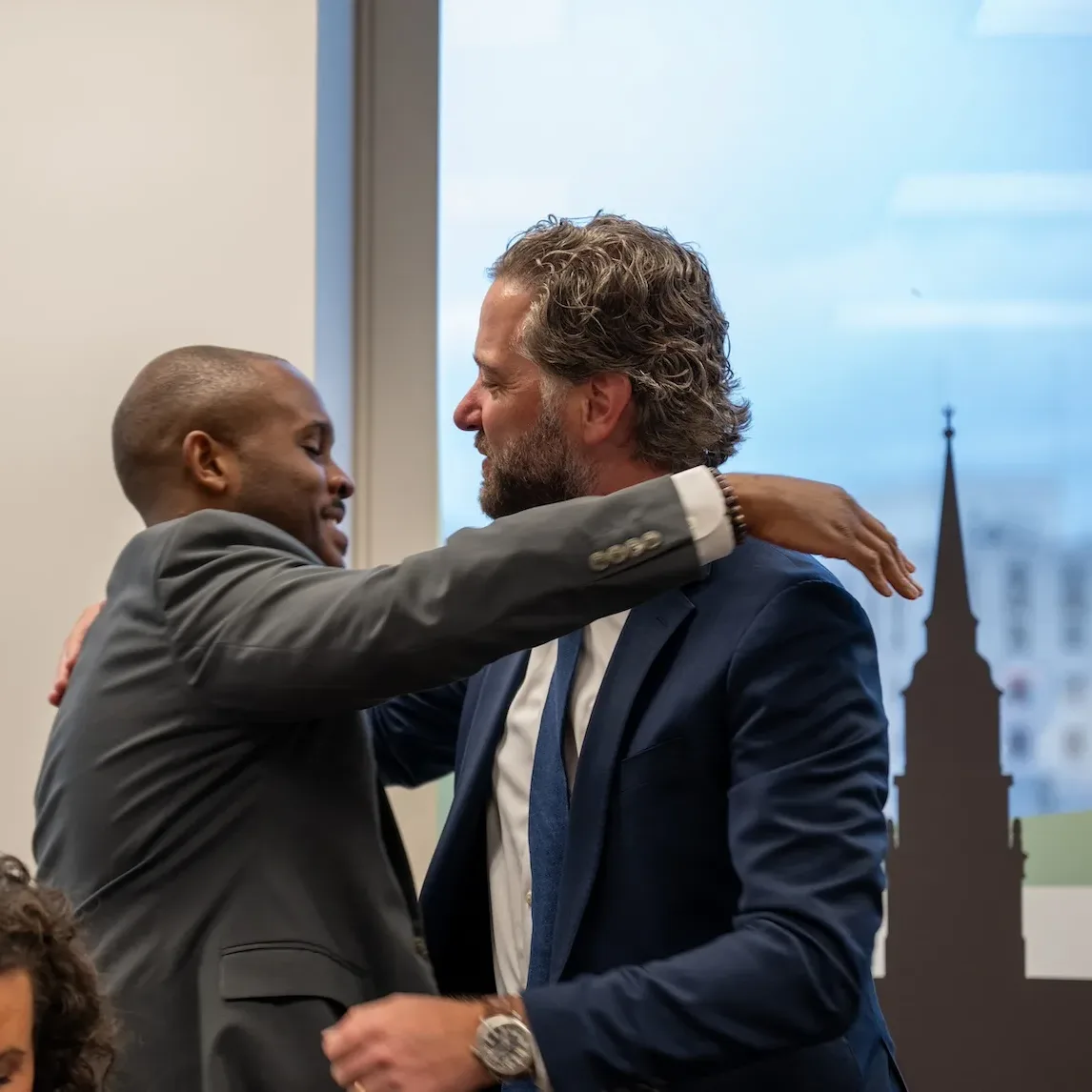
During Ramsey’s term 23 years ago, he learned from longtime student-life administrator Mike Ford (’72), son of President Gerald Ford (P ’72, LLD ’80), that the art of leadership is “to try to get other people to want to do the thing that you want them to do.”
When a fraternity vacated a student lounge on the Quad, Ramsey and his executive team swung into action to turn it into Campus Grounds, a student-run coffee house still caffeinating undergrads today. Their secret weapon: then-President Thomas K. Hearn Jr. (LHD ’04). “We knew President Hearn was a great scholar of 19th-century Austria, where coffee culture was king,” Ramsey says. “We were able to appeal to him and get the project done at warp speed.”
As chief of staff at the Library of Congress, whose mission is to engage, inspire and inform Congress and the American people as an enduring source of knowledge and creativity, he influences projects ranging from the National Book Festival, featuring 100 authors, to filmmaking preservation with Martin Scorsese and other luminaries. “I think in most things that I do today in my job, and that I’ve done for the last 20 years, I’ve tried to build coalitions and bring people along, using the training that Wake Forest taught me,” he says.
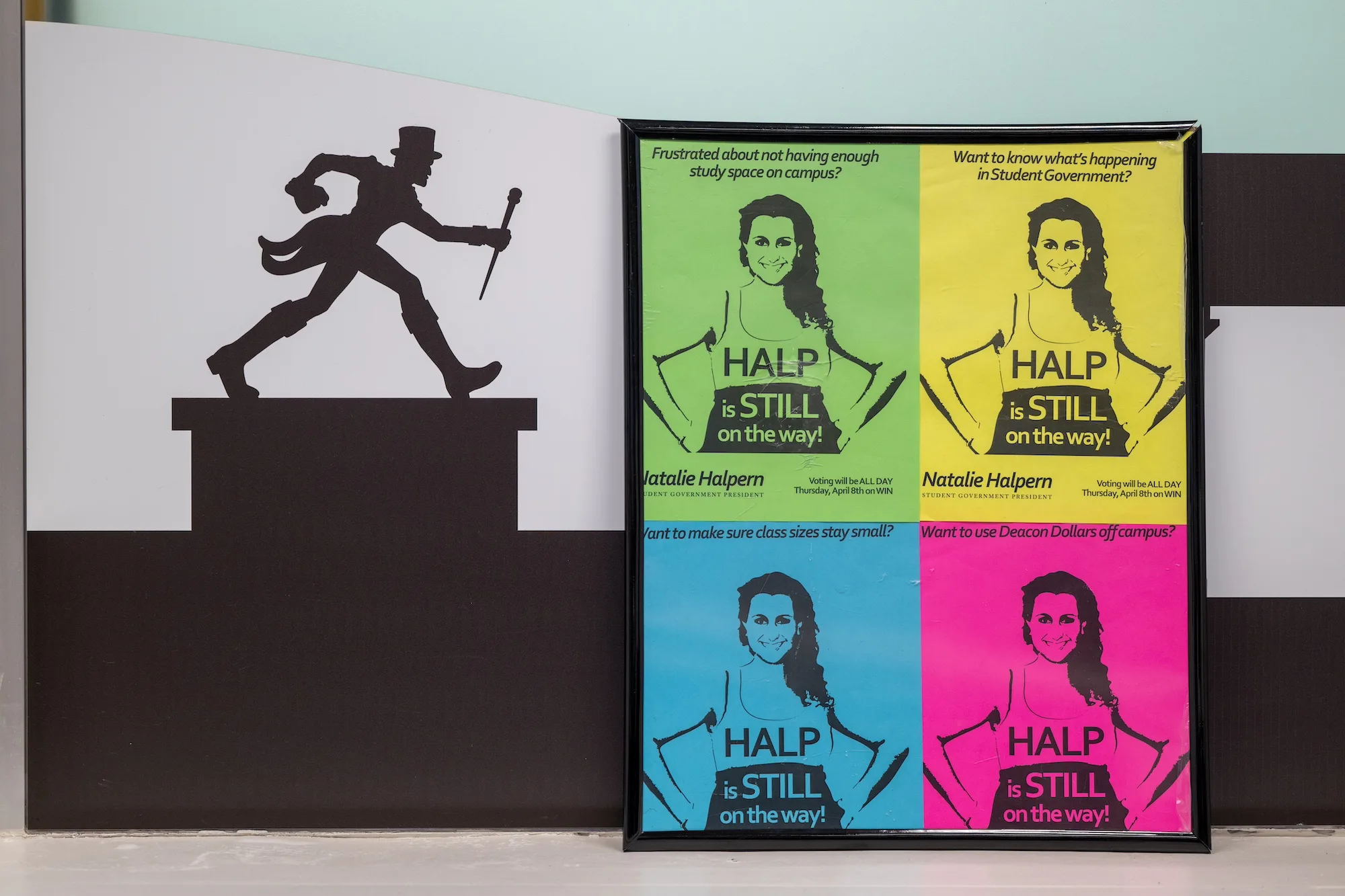
When Hales took office in 2011, students were clamoring for more space — for both studying and socializing. SG advocated to open classroom space for studying, especially during exams, and expanded “Seize the Quad,” an on-campus bash, she says.
Now, as the American Dental Association’s main conduit to Congress, she advocates for a bipartisan group and works on both sides of the aisle to push for better coverage of oral health, including fixing children’s cleft palates, missing teeth and other problems that make it hard to eat or breathe normally, she says.
Through it all, she’s taken the same approach she used during her presidency: “It’s always been really important for me for things to feel like group efforts, and everyone (feeling) really comfortable with decisions as much as possible,” she says.
“Most importantly for me was knowing that, even though I was student body president, it was not just going to be all about what I wanted to do or what my thoughts and opinions were,” Hales says. “I really tried to view it as an opportunity to get buy-in and surround myself with people who would be really honest with me. I think that made me a strong leader at that point, and has continued with me to this point, because I know that if you’re a leader who isn’t challenged, that is actually going to come back to hurt you in the long run.”
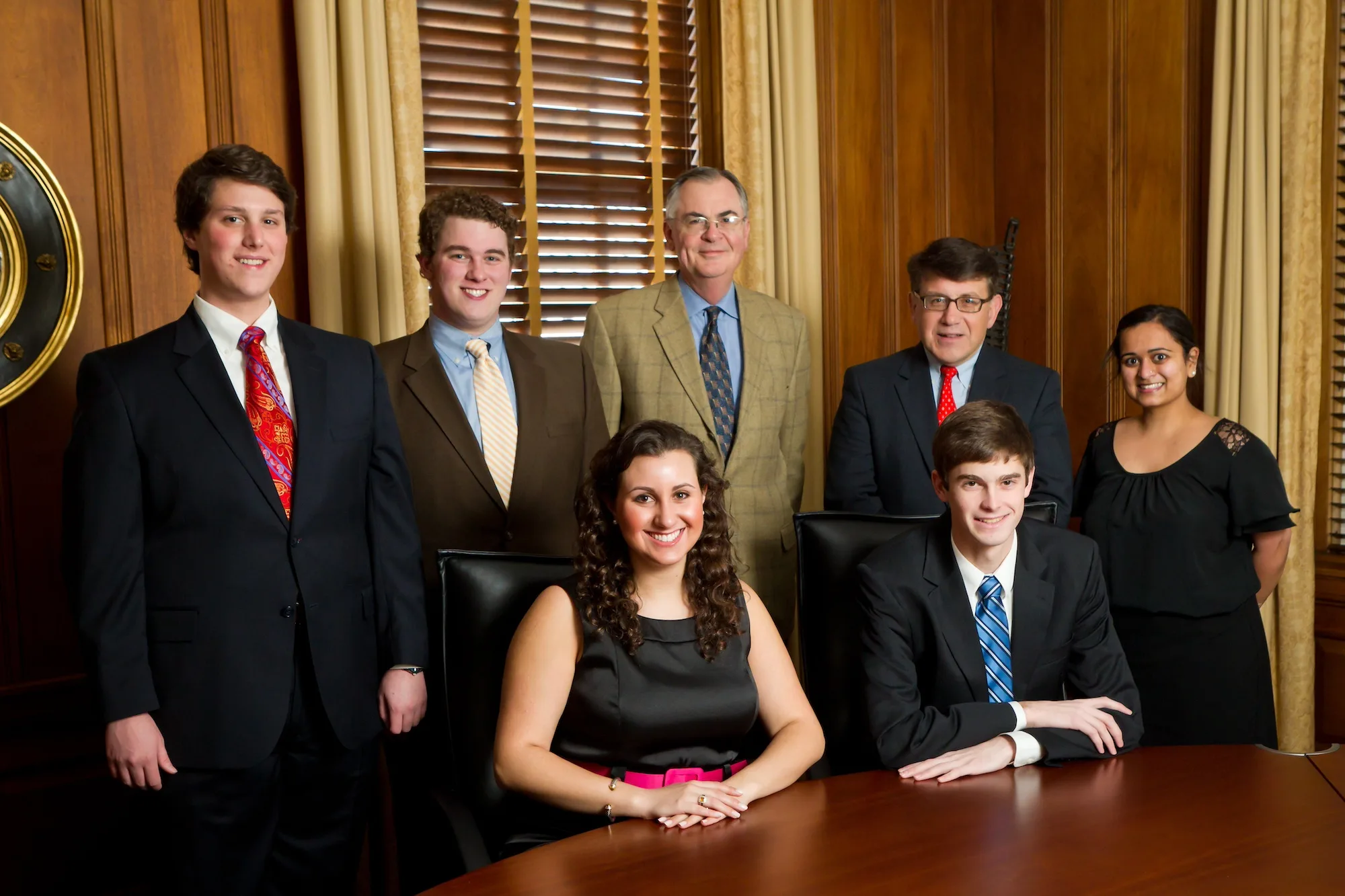
Shortly after Hannah Elluru (’25) took office in spring 2024, campus anti-war demonstrations and encampments escalated, demanding her attention. “It was challenging, but also a good lesson in thinking fast on my feet and turning to people to ask questions and not just thinking that I had everything figured out,” she says.
Her canvassing of previous student leaders, other SG executives and University administrators helped start campuswide conversations about freedom of expression, she says. “It was not something I had really thought about going into my senior year in Student Government, but it was the thing I became very passionate about.” It’s a passion she took with her to Georgetown University Law Center, where she is in her second year.
Sutherland also learned to proactively pivot while she was SG president. “You spend a lot of your time working on your campaign, but then so much of your presidency becomes reacting to events that unfold,” she says. “When I think about my career in government, almost all of it has been managing or working on crises, so I really try to anticipate what’s coming around the bend, and then try to craft a flexible and agile strategy so we can best navigate that when it inevitably comes.”
Current president Gray Lowder (’27) spent fall 2025 at Wake Washington. He interned for Speaker of the House Mike Johnson, R-La., for five weeks, until the federal government shut down, and then did research at the Consumer Bankers Association.
Lowder’s time in Washington affirmed his goal of making Student Government a more visible advocate for student interests. His main concerns: housing and dining. In April, shortly after he was elected, Student Government garnered attention with a resolution opposing further enrollment increases without adequate facilities. He has been heartened by expanded food options on North campus and incentives to better balance the number of students going overseas in spring instead of fall.
Student Government traditionally gets a heads-up on administration announcements, but not much input, Lowder says. Now, “I’m having impromptu phone calls about things, and we’re putting in our two cents.”
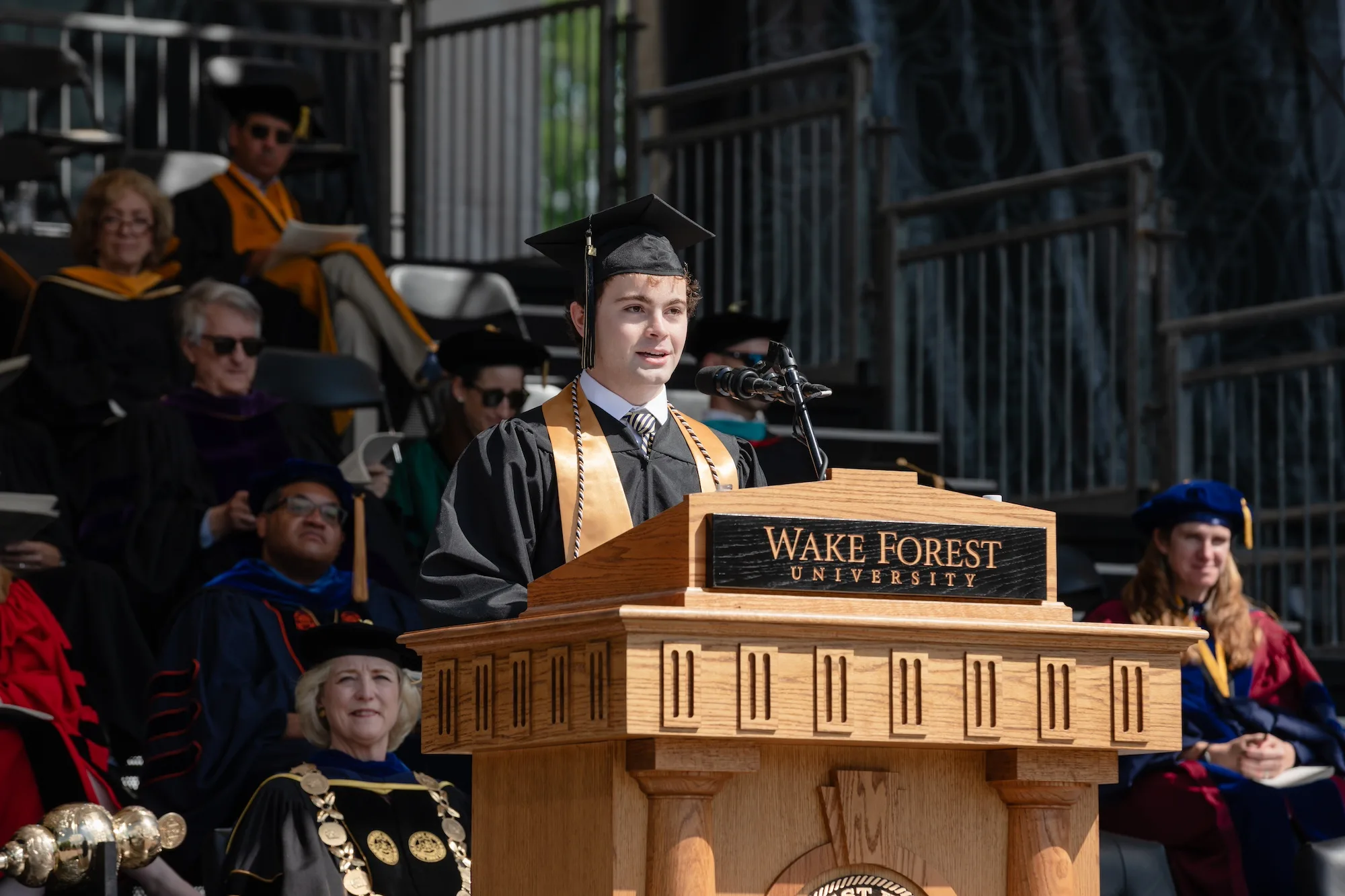
Jackson Buttler (’24) faced hurdles unlike almost any other SG member. As a first-year in Student Government, he was named SG liaison to the University’s administration on COVID-19 issues. In the October of his presidential term, the latest Israel-Hamas war broke out.
Buttler found guidance from a predecessor, Ally Swartzberg (’22), he says. She “told me something about leadership that I still think about to this day: ‘The true mark of a great leader is making a decision in a challenging time and being able to stick with that decision.’” He also consulted frequently with Monaghan and Reeves, who advised him to focus on University issues where students needed Student Government’s direct help, rather than international conflicts.
“As president, you allocate all of the student-activity funds to all the organizations. So, you’re managing a $1 million-plus budget. You’re not only effectively representing 5,400 undergrads, you’re also leading an organization of 100-some people who all have different beliefs, and you’re trying to bring everyone together,” Buttler says. “I’m really proud that we didn’t have any big drama happen, because I think I became really adept in navigating those sorts of things.”
He essentially created his own board of advisers, mainly presidential alumni. Monaghan, for example, was working in Raleigh, Buttler’s hometown, so Buttler would ask Monaghan to coffee — and they even ran a marathon together. “When I became president,” Buttler says, “I would call Jordan about everything, just because he was such a helpful resource for me.”
Buttler is now deputy national press secretary for the Democratic Senatorial Campaign Committee —a job Monaghan encouraged him to go for, and at the same organization where Ramsey worked years ago.
“My biggest piece of advice to current students,” he says, “is don’t be scared to reach out to those who are older and have the experience and wisdom to provide to you, because they want to offer it as much as you want to ask for it.”
More Stories
Fit? Check.
President Peter Rodriguez has landed at a university that is “congruent” with his background and his values.
Shining a light on Wake Women
Wake Forest is not a single story. It is the sum of every individual experience of those who have passed through this institution.
Back to School
These four Deacs see big opportunities for Wake Forest and its new president.