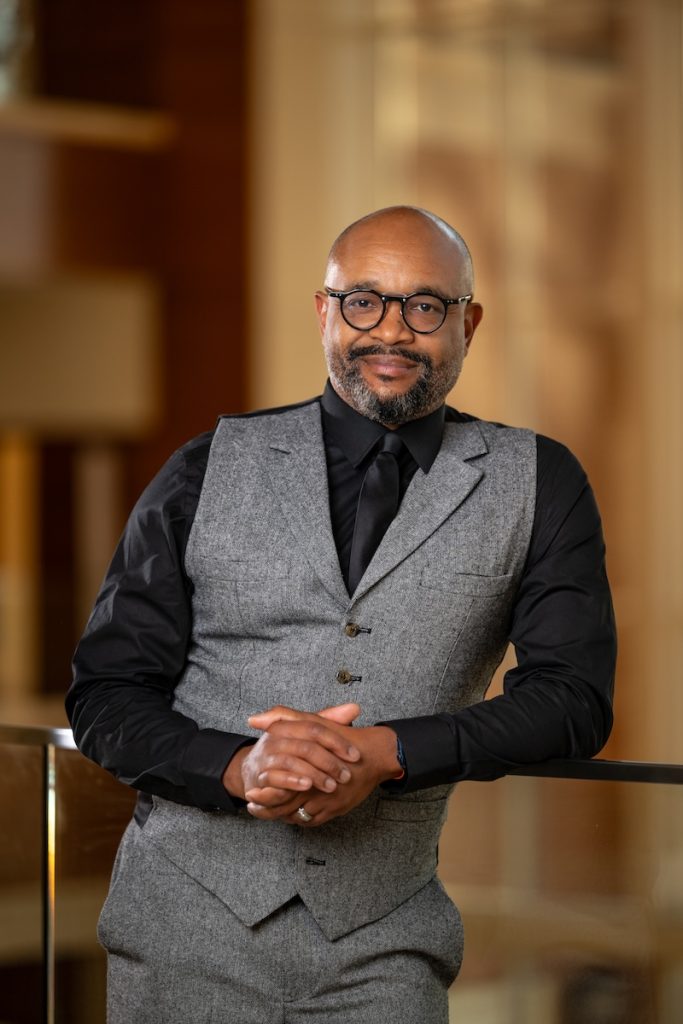
Last fall, the University welcomed Chad Cheek (MBA ’05) as associate vice president of University Advancement strategy, marketing and communications and editor-in-chief of Wake Forest Magazine. A Winston-Salem native and highly respected leader in branding, design and community arts management, Cheek brings more than 35 years of industry expertise to the magazine. He has a proven record of launching and building brands, leading teams and directing graphic design and innovative communication solutions. He comes to Wake Forest after a nearly two-decade long stint as owner and managing director of Elephant In The Room, a boutique creative agency based in Winston-Salem.
As a passionate community advocate, Cheek has served for decades on various nonprofit boards. He also worked on a team to collaboratively design what is expected to be the largest piece of public art in Winston-
Salem’s history. He lends his strategic vision to state-level arts nonprofit initiatives, serves on the executive committee of the North Carolina Arts Council Board of Directors and is currently president of the board of directors for the North Carolina Arts Foundation.
Cheek spoke with Assistant Vice President of Advancement Strategy, Marketing and Communications Elaine Tooley about his background and vision for Wake Forest Magazine moving forward. Here are excerpts from their conversation, edited for length and clarity.
Elaine Tooley: I understand that Winston-Salem is your hometown. Tell us about growing up in Winston-Salem and being part of this vibrant community.
Chad Cheek: For as long as I can remember, Wake Forest has had a significant influence on how I have viewed the world and my role in it. The impact has been indelible. Early in my career, I began to work in the community and was eventually invited to sit on various community boards. Board members — including Wake Forest faculty, staff and alumni — helped me understand clearly that volunteering and bringing expertise to nonprofit, community endeavors was just as important as the work we were getting paid to do. At the time, I didn’t fully grasp the meaning of Pro Humanitate, but the idea of doing hard work on behalf of others resonated with me, and I continue to work on nonprofit boards to this day. I can also remember being 13 or 14 years old, sitting in the barber shop and meeting and talking with Muggsy Bogues (’87, P ’09) on more than one occasion. It was neat for me to have the chance to sit and talk to Muggsy — a guy who was such a big deal for the basketball program that I was rooting for. What I remember most is how nice he was and how fondly he talked about his experience at Wake Forest and what hard work meant to him. (Other Wake Forest basketball players came into the shop as well — Danny Young (’84), Delaney Rudd (’85), Anthony Teachey (’85), Derrick McQueen (’92), Rodney Rogers (’94, L.H.D. ’22), Randolph Childress (’95, P ’20) and Tim Duncan (’97).)
ET: You graduated with an MBA from Wake Forest School of Business. What made you choose to pursue your education at Wake Forest?
CC: I had the good fortune of working with people who had decided to stay in Winston-Salem after getting a business degree from Wake Forest. They always showed up in unique ways that stood apart from our other colleagues, and it made a strong impression on me. When it was time for me to contemplate applying to business school, I looked at all the options available to me and decided that an MBA from Wake Forest was the only option. I decided to work really hard to get in, but I also remember making the decision that if I wasn’t able to get into the MBA program at Wake Forest, I would not go anywhere. I wanted the ability to show up in conversations and try my hand at unique approaches to innovative problem-solving like I had observed for years by alumni of the business school. Ultimately, it was extremely significant for me to have the opportunity to earn a degree from the school that I rooted for my whole life.
ET: How did your experience at Wake Forest shape your career?
CC: I decided I wanted to get an MBA to confirm what I thought was true about business and strategy and leave behind the things that were not sound. I knew I had a lot I wanted to learn. I got everything I was hoping for and more. I came away from the experience truly knowing how to think. I was able to apply what I had learned to my own work and the work I would eventually do for clients. Having the ability to go beyond simply identifying a problem to understanding how to deeply contemplate solutions from multiple angles has been an invaluable skill that I attribute to the strategic thinking that I learned from my professors and my classmates at Wake Forest.
ET: What were some key experiences that shaped how you have guided teams of marketing and communication professionals?
CC: One of the things I can distinctly remember about the experience is being challenged by one of my business school teammates to work harder on a group assignment. It was early in our working together as a cohort, and my first effort in the assignment was not up to par. He discreetly pulled me aside and challenged me to step up and pull my weight, highlighting that I was a valuable member of the team and I was being counted on. He pointed out that I was there for a reason, and I was capable of more than I had just given. That encounter had a profound effect on my work ethic in the program. It also showed the importance of holding teammates accountable even when it created the necessity of having tough conversations. That same teammate of mine happens to now be an assistant professor of practice at the School of Professional Studies.
ET: As you look to the future, what is your vision for Wake Forest Magazine?
CC: I would categorize the vision in two distinct ways. First, I hope to protect and preserve the great legacy of this magazine to beautifully tell compelling stories of phenomenal alumni exemplifying Pro Humanitate in the world at large. Second, I want to expand our ability to tell stories in even more dynamic ways while increasing access to the content beyond the ways we are currently. I’m also excited to explore opportunities to transport the great things happening on our various campuses to our growing community of Wake Foresters around the world.
ET: Is there anything else you would like to share with the Wake Forest community?
CC: I would love to hear from readers! I want to understand not only what people enjoy but also any ideas or suggestions that folks may have as we seek to contemplate how to make the magazine even better. Please feel free to reach out to me at editor@wfu.edu.