We are living through one of toughest periods to work in federal government service in the nation’s history. Hundreds of thousands have left the federal workforce in recent years, and public opinion of Congress and the federal government is overwhelmingly negative, according to a study released this month by the Partnership for Public Service.
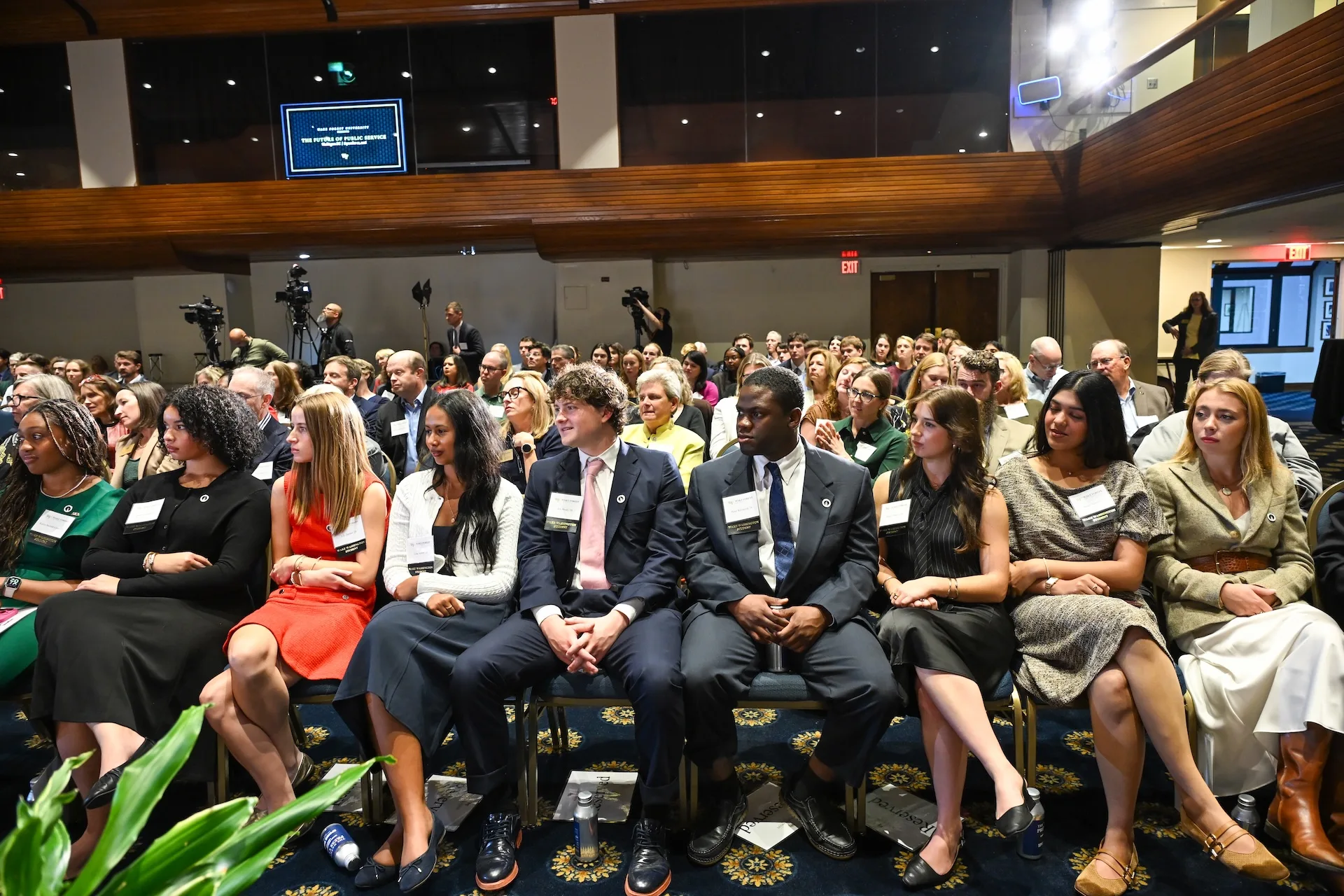
What does the future hold for public service? Wake Washington convened a panel Tuesday night at the National Press Club in Washington to discuss that question. The University tapped three veteran public officials. Former U.S. Rep. Donna Edwards (’80), D-Md., U.S. Sen. Thom Tillis, R-N.C., and Max Stier, president and CEO of the Partnership for Public Service, a nonprofit that works to improve the federal government, participated in the panel moderated by Michael Lamb, senior executive director of Wake Forest’s Program for Leadership and Character.
The discussion focused on federal workers and civil servants, scores of whom were among the alumni, parents and others in attendance. Public service is a point of emphasis for the Wake Washington program, now in its 10th year of programming for students who spend a semester working and taking courses from Wake Forest professors in the nation’s capital.
“We’ve really been working on bringing students here to Washington, D.C., to learn about public service, to demonstrate the skills that it takes to lead effectively and to grow as individuals,” President Peter Rodriguez said in his opening remarks.
Here are four insights from the panelists about the state of public service, its importance to our country and opportunities to improve it.
1. Public service has a public image problem.
Stier lamented the public’s misunderstanding of government service and the people performing it. “You ask people if they trust the federal government today, they think about bickering politicians in Washington,” he said. “They do not think about the millions of civil servants who are career folk doing the public’s business.”
“We’re very bad storytellers about government, and we need to invest in that,” Stier added. “We do need to have better government, we need to have better leaders in government, and we need to do a better job communicating the value proposition.”
Edwards blames the public’s negative perception on decades of politicians’ using the federal workforce as a punching bag: “I go to the last 40 years of beating up government, saying government can’t do anything right, the people who are in government are not performing the way that they should.”
She said those negative views primed the public for the second Trump administration’s Department of Government Efficiency, or DOGE, the cost-cutting measure that spearheaded federal government-wide layoffs and resignations. “You’ve already conditioned the public to believe that government and the people who work in it are worthless and can’t get a job done.”
Tillis called DOGE “well-intended, horribly executed.” One of its lingering effects is a recruitment problem for the federal government, casting uncertainty over what had previously been viewed as a stable, impactful career path that attracted young talent.
“Some of the most extraordinary people I have met in the world work in career foreign service for the U.S. government,” Tillis said, reflecting on staff he met on a recent trip to Ukraine. “We’ve got to let people know that that’s a great profession.”
For Grace Taylor (’28), a Wake Washington student, the bipartisan discussion crystallized the disconnect between the work of civil servants and the public’s perception.
“When people think of public service now, it’s as just a black hole where nothing ever gets done that’s purposeful and meaningful to our actual communities. They’re not seeing the work that’s being done. [Tillis and Edwards] don’t want that to be this way,” Taylor said. “We actually have meaningful work being done. When you lose the partisanship, you remember the purpose of it for the American people.”
There is a silver lining to the cuts of the past few years, Stier pointed out. “You’re seeing, to some degree, loss aversion, where people are not getting services that they expect to get and used to get, and they’re starting to pay attention to why that is,” he said. “And so, we’ve seen a 10-point jump in Americans saying civil servants are helping people like them, a 10-point jump in positive views.”
2. In public service, you’ve got options.
The panelists agreed on the value of public service, but differed on the best way to approach it as a career.
Edwards recalled civil service exams being the norm when she graduated from high school, presenting opportunities for students who weren’t bound for college. Tillis, who worked in management consulting before entering politics, recommended doing government work outside of prime earning years. “Either make money ahead of time or do it early, then go make money. Then come back on your own terms,” he said.
Stier countered with different advice: “There are three things you want in any job, and that is purpose, working with great people and real responsibility. My view is, you start best if you can find that purpose at the very outset.”
Edwards highlighted how many different interests can find a home in government work. “If, growing up, you love counting bugs and looking at bugs, you can find a place for yourself in the civil service,” she said. “There are all kinds of ways that you can find yourself and find your passion in government service.”
Tillis added that staff for members of Congress do important work for constituents, particularly those who work in their home states. “It’s amazing what those folks do, and how it recharges my battery to see just literally life-saving results,” he said. On a recent trip, a constituent approached Tillis in the airport. “He had run into me maybe about six months earlier. I gave him a direct contact to my staff. The only thing I did was to hand off,” he said, “but they literally saved this person’s life by getting [his mother] to this country and giving her a treatment that would otherwise not have occurred in Africa.”
The range of options clicked with Amna Ahmed (’27). “As someone navigating the job market and what I want to do in the future, [what] really stuck out to me is you don’t have to have your whole life planned,” Ahmed said. “You don’t have to have your whole career planned. Public service doesn’t have to be a career — it could be one opportunity that you have post-grad that could turn into another opportunity.”
3. A Pro Humanitate path
For Peter Raymond (’28), the discussion prompted an understanding that public service is less about career trajectory than it is about helping others. “Even though we may go into these positions that last two to four years, the central purpose is to give back to the entire public, not ourselves,” he said.
Lamb prompted all the panelists to describe role models who showed them what public servants could accomplish. For Edwards, it was her mother, a civil engineer in the U.S. Department of Defense. Edwards recalled a time her mother came home from work elated, because she had been recognized for uncovering a huge overcharge by a contractor. “You would have thought that she had hit the lottery, not because of the award that she got, but because she found the overcharge, and it meant that she saved taxpayers’ money.”
Stier named Anne Bingaman, his former boss at the U.S. Department of Justice, as someone “who really was committed to institutional health, something that you rarely see in leaders,” while Tillis mentioned Sen. Mitch McConnell (R-Ky.) as a mentor. McConnell “can look around corners the way I never could,” Tillis said.
The panelists described how those and other exemplars inspired them to be more effective as public servants — not just better at forging a career or winning arguments.
“In public service, you can find the common good, and you can find where you fit in it … but you can also do something that gives value to somebody else’s life and not just to your own,” Edwards said. “It may turn out that you make a career at it. You do some research that changes people’s lives, or you count the bugs that you always wanted to count when you were 6 years old. But you do it in service of humanity.”
4. There are systemic issues in the federal government — and reasons to be optimistic.
The panelists discussed some of the big issues plaguing federal government work that contribute to its bad rap, including a glut of political appointees in federal agencies and a reluctance to innovate. In Congress in particular, Tillis sees “a lot of reward in today’s politics for performance, but not a lot of reward for production.”
Stier suggested a more solutions-focused approach to public service. “We have a lot of infrastructure to find problems in government … but you don’t actually solve those problems simply by looking for problems,” he said. “You solve problems by actually looking for answers and good things, and those answers then change government.”
Tillis looked to the students and early career professionals in attendance, saying theirs is “the best generation that’s ever lived in this country. … You’re smarter, you have more resources, you’re more respectful of ethnicities and cultures. … Part of the solution is what you all do. To what extent you emulate positive behavior, become role models for the next generation.”
Edwards, who belongs to a bipartisan group made up of former members of Congress who visit colleges, agreed. “Every single time our members come away, they say, ‘We’re gonna be OK,’ “ she said. “Because of the questions that are asked, the thoughtfulness that students have about this country, about our system, their willingness to work to make things better in their communities in our country.”
Olivia Ford (’28) was surprised and heartened by their optimism: “It was kind of emotional for me to think that these powerful people are looking at all of us sitting on the sidelines and saying, ‘We have hope.’ It makes you feel like I can make a change and we all can make a change.”