Back to School
These four Deacs see big opportunities for Wake Forest and its new president.
By Kelly Greene (’91)
ILLUSTRATIONS BY MONA EING & MICHAEL MEISSNER
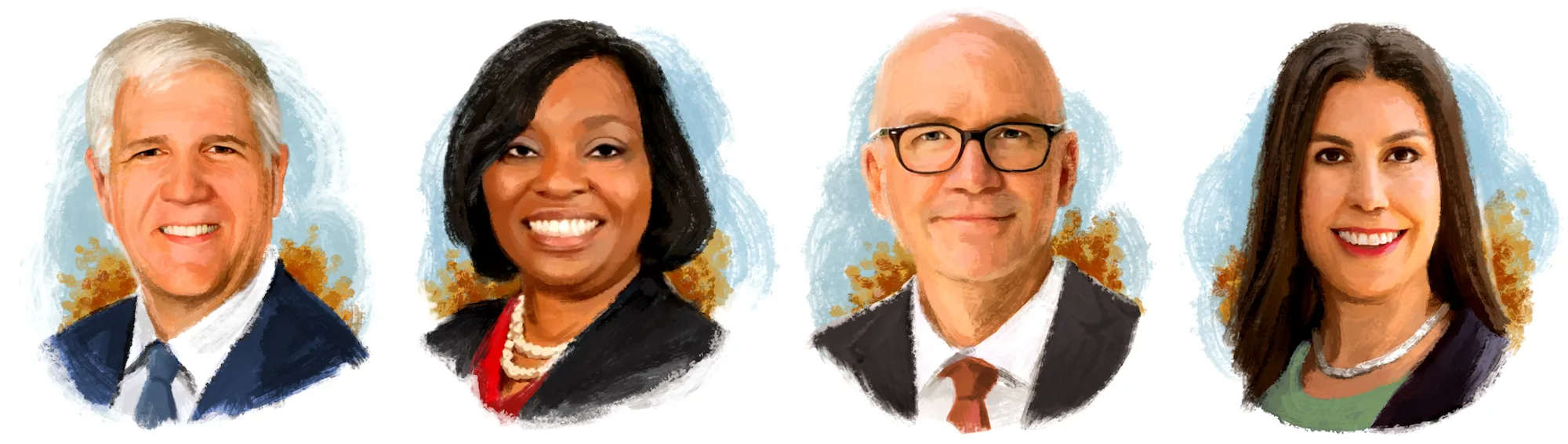

We asked several Wake Forest alumni leading higher education institutions across the country to share their insights as President Rodriguez begins his tenure.
• Ed Bonahue (’87), President, Suffolk County (N.Y.) Community College
• Bonita (Hairston) Brown (’94, JD ’97), Chancellor, Winston-Salem State University
• Peter Mohler (’95), President, The University of Alabama
• Rachel Davis Mersey (’00), Executive Vice President and Provost, Southern Methodist University
They remember what they loved at Wake Forest —and what he will, too.
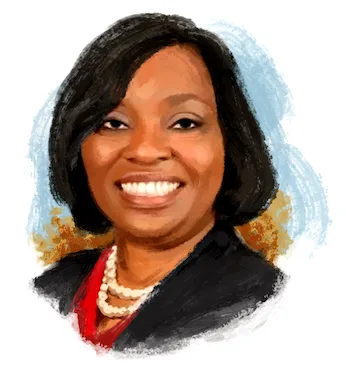
Brown: Wake Forest’s smaller numbers, personalized education and mentorship — I think they need to keep that. A lot of the elite schools, larger schools, are losing that touch. I think that’s going to be Wake Forest’s secret sauce. And there’s something to be said about the different perspectives you can gain from people who’ve had different experiences. It just makes the University stronger. And so if Wake Forest can continue to lean into that in the ways they have done in the past, I think that’s going to make them powerful.
Bonahue: For me, Wake Forest was a really eye-opening experience in terms of exposure to the liberal arts and sciences. I took seriously that it was the foundation for lifelong learning, that there were so many things you could get from a liberal arts education, just all the general education pieces that students sometimes complain about because it doesn’t seem directly related to your career. But in my case, I think it made me curious. It gave me breadth in terms of my appreciation for all the academic disciplines. And in some ways, that set me up for being first a chief academic officer and then as president. It was great that I had had the privilege of having to take a core bio class and a calculus class. It meant that I had some basic understanding of what faculty in those areas really valued. And that’s really been helpful.
Mohler: I had a great mentor (Biology Professor Emerita Carole Gibson) and people that really invested time in me that didn’t have to and got me involved and really changed the course of my career. So I owe where I am today to Wake, and it’s pushed me as a leader in this position to really think about the university not just as a population of students, but where every student really matters.
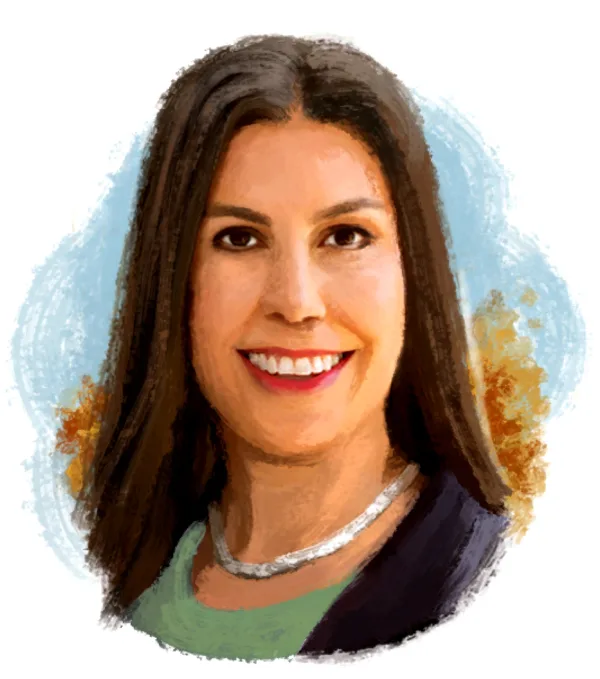
Rachel Davis Mersey (’00)
Mersey: Wake is the perfect size to be able to have incredible opportunities, but small enough to still be intimate. And I think that’s one of Wake’s most special assets. But I also think its relationship with Winston-Salem is important, and the way the University engages with the community. (Students have) the opportunity to be within a community that’s not so overwhelming, that’s not so all-encompas-
sing. Wake is truly part of the center of gravity in Winston-Salem. You’ll never have the most alumni in the country, but the willingness of Wake alums to watch out for other Demon Deacons is really special. People just care for each other in a way that doesn’t always happen at a huge institution.
They told us what excites them about Wake Forest’s next chapter.
Mersey: For me, a big part of it was the Pro Humanitate piece of the education, that it wasn’t just about what you were going to learn in the classroom, but your character development inside and outside of the classroom. Thinking about the types of leaders that Wake is going to put out into the world, regardless of their major, is why I chose Wake — and I think that’s something important for a new president to know to capture and to capitalize on. … And then there is the network.
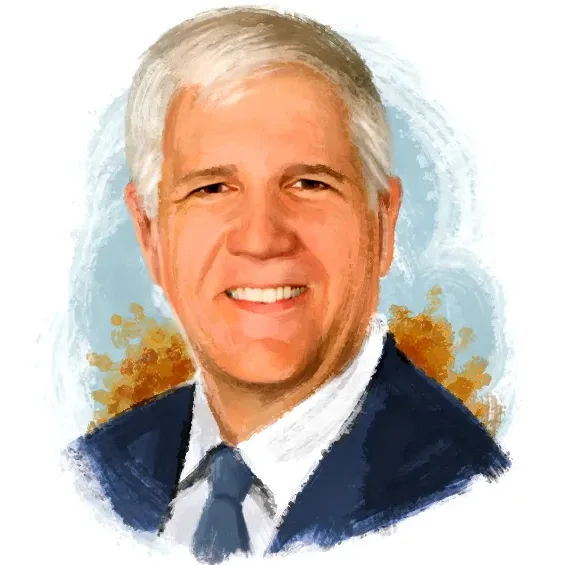
Ed Bonahue (’87)
Bonahue: Higher education is not only devoted to research and the pursuit of new knowledge and to developing the next generation of leaders, but in my tier of higher education, it’s devoted to access to opportunity. And access to educational opportunity also means access to economic opportunity. I’m really delighted to see that Wake Forest is creating that access. I think the commitment is good for Wake. It’s a great platform for social change.
Brown: I hope that all the partnerships that Wake Forest has continue with (Winston-Salem State), and I hope we can do more. We have the physician assistant partnership, the Wake Law partnership, we have a research partnership with the Institute for Regenerative Medicine. Those partnerships show that Wake Forest is serious about collaboration, is serious about getting to the answers for these great societal problems and challenges, and they’re going to work with everybody to get to those answers. Wake Forest is a good anchor institution for Winston-
Salem, as are we. Together we can have a powerful voice for this city and for the region.
They shared how they’re thinking about leading in higher education now.
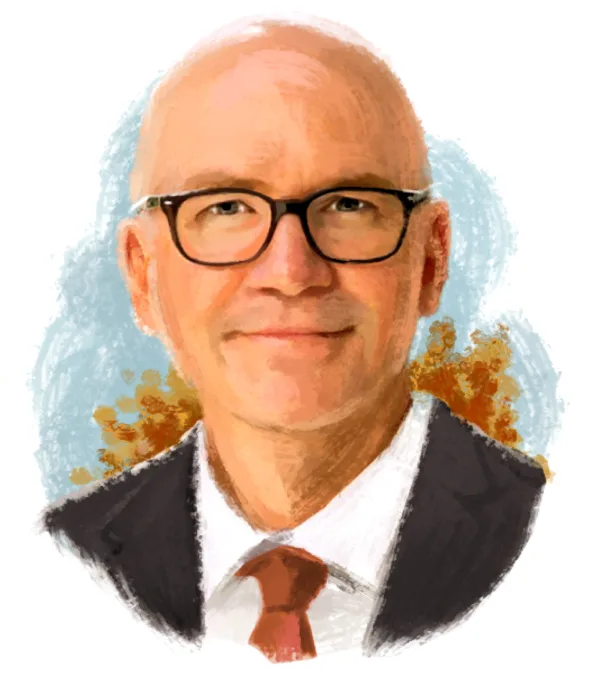
Mohler: We’re at this very, very important time in history where so much is changing. So much is changing both from a worldview and a country view, but also with all these enabling technologies, that the link between a single discipline in a future career isn’t a direct line anymore. It’s more important than ever that we’re really making sure that we empower the students to not just be able to be great at physics or chemistry or economics or literature, but we really teach them not what to think, but really how to think, and how to evolve and how to pivot. I think “pivot” is going to be the most important word going forward for the next generation. …
There are a lot of people that are very worried about higher education now. I think if we approach it the right way and almost say, “We’re going to stop thinking or worrying about what happened 50 years ago,” and (instead) say, “What are the tools that we need to give our kids for the world ahead of us?” then it’s a really exciting time.
Brown: Storms are going to come. We’re just at a time where nothing is normal. And so every day is going to be a new challenge and adventure and you just have to embrace that and know that it’s going to be difficult. At the same time, remain inspired by the innovation and excellence that’s on the campus. Those faculty over there are phenomenal. You have the resources, you have the facilities. Just embrace that and celebrate that and magnify that at all turns.
More Stories
Fit? Check.
President Peter Rodriguez has landed at a university that is “congruent” with his background and his values.
Shining a light on Wake Women
Wake Forest is not a single story. It is the sum of every individual experience of those who have passed through this institution.
Constant & True: Carson Markland (’20)
The author of a new novel about the Kennedy brothers says they provided a template for leading in the 21st century.