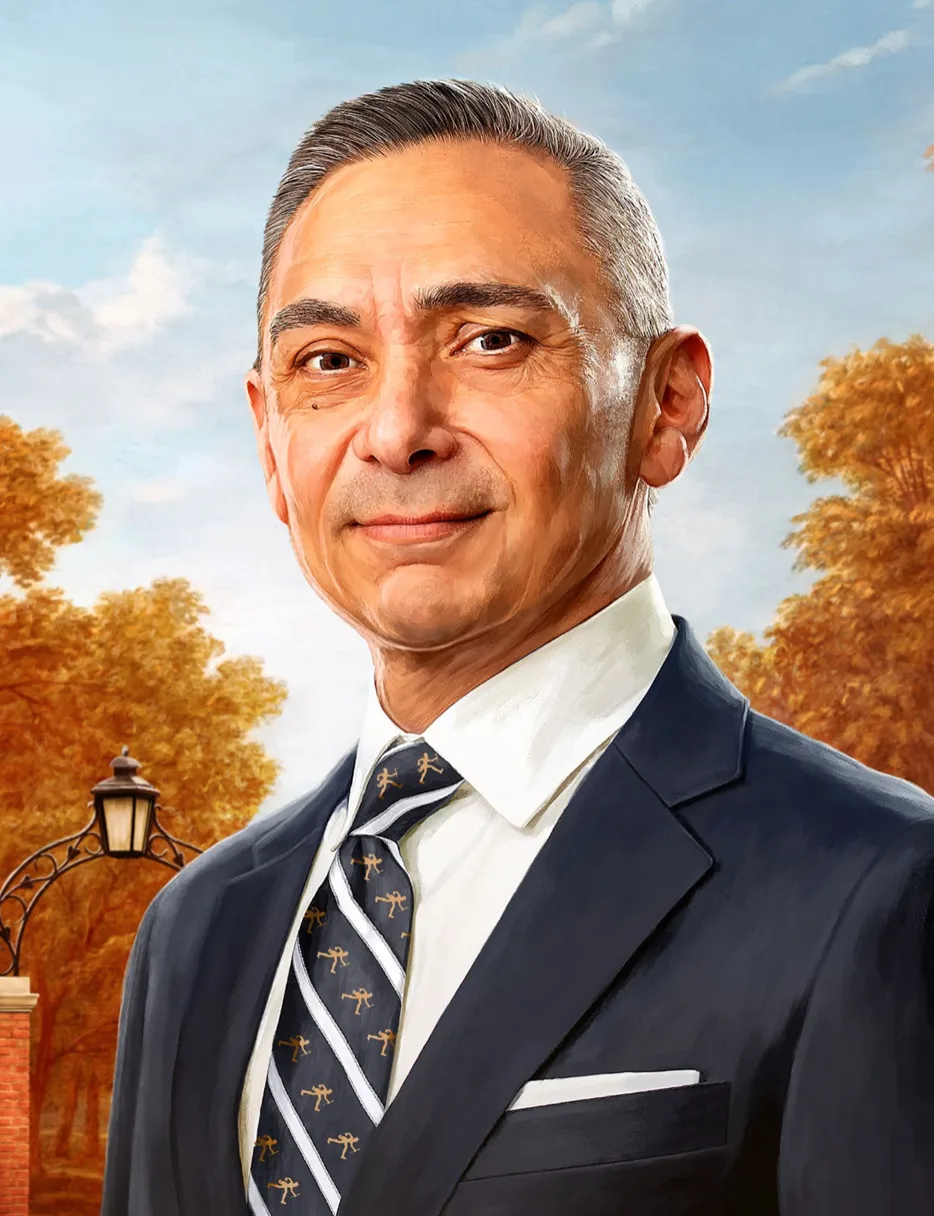
Fit?
Check.
President Peter Rodriguez has landed at a university that is “congruent” with his background and his values.
By Elaine Tooley
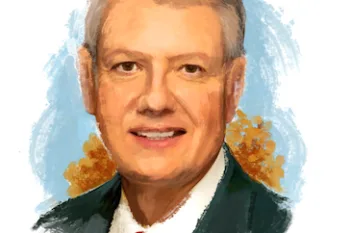
Illustration by Mona Eing & Michael Meissner
Peter Rodriguez reached into the cardboard box, retrieved another 3.5-inch floppy disk, and slotted it into the computer drive. He and his mentor, Professor Arthur James, stared at the glowing monitor, examining the data that would bolster the student’s ideas.
It was 1989, and faculty members at Texas A&M had encouraged the economics major to write a senior thesis on a topic that truly fascinated him: airline deregulation. Intrigued but starving for raw data to elevate his analysis, Rodriguez had hit a wall in his research. Sensing his student’s drive, James encouraged Rodriguez to contact influential economist Severin Borenstein. Weeks later, a heavy box of floppy disks arrived in the mail with a handwritten note: “Do your best.”
Because Rodriguez didn’t own a computer, James opened his own home to the young scholar. The two spent months dissecting the specifics of load factors, revenue passenger miles and yield management — analyzing how a newly free market dictated flight frequencies and ticket prices through the principles of supply and demand.
“I was at Professor James’ house day and night,” remembers Rodriguez. “If I stayed there long enough, his wife would make me grilled cheese sandwiches.”
In March 1990, Rodriguez published “Economic Impacts of Airline Deregulation,” earning the title of Outstanding Undergraduate Researcher in the Social Sciences. The paper was much more than an academic milestone. It set him on a career that has been defined by academic achievements and a commitment to paying forward the mentoring he received.
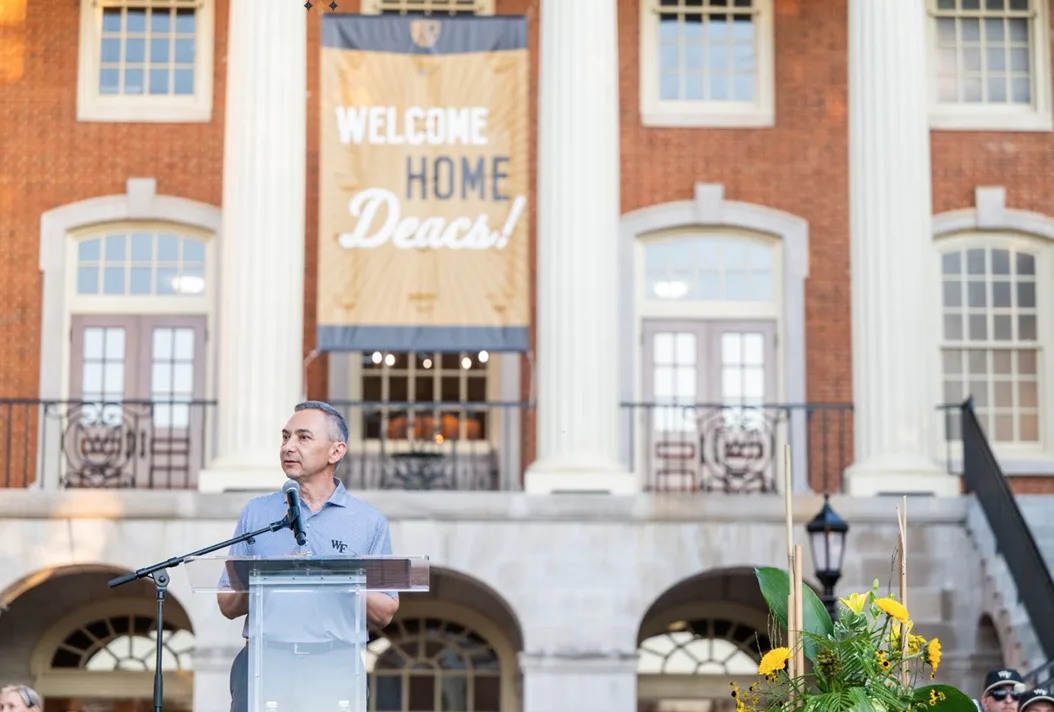
On July 1, Wake Forest officially welcomed Peter Rodriguez as its 15th president. He is an economist and professor of strategic management who has spent his career at the intersection of business, leadership and education. Having lived and worked within the educational environments of Texas A&M, Princeton, the University of Virginia and Rice University, he is now at the helm of Wake Forest with a deep sense of alignment.
“I’m so optimistic about what I see at Wake Forest,” Rodriguez told the University Board of Trustees over the summer. “I feel it’s so congruent with my own background and where I come from.”
His instinct to seek out demanding and transformative education didn’t happen by accident. It was forged by his parents, Pete and Dee, who modeled two distinct definitions of grit.
His father, Pete, first stepped onto the Texas A&M campus as a catcher for the baseball team. “I don’t think he expected to love organic chemistry,” Rodriguez laughs. Yet that unexpected spark led Pete to earn a PhD in the field, eventually becoming a university professor himself.
“My dad changed our entire family’s trajectory,” Rodriguez says. “He opened up a world of opportunities. He was inquisitive, scientific and challenging — a wonderful, charismatic guy who made me feel confident in math and science. Without even knowing it, I was born believing I belonged at a university.”
His mother, Dee, instilled a different but equally fierce standard of excellence. She entered the workforce as a secretary in the 1970s and refused to stop there. The first in her family to pursue higher education, she attended night school for 12 years. She took a single class at a time while working full-time and raising her family. She never earned a grade lower than an A.
“You can’t offer an excuse to a woman like that,” Rodriguez says. “My mother was tougher than all of us put together. She expected so much of herself, we couldn’t expect less of ourselves. More than anything, my parents taught me that education was a virtuous path — one aimed at moral formation and being part of something bigger than yourself.”
That foundational drive carried Rodriguez far beyond his home state of Texas. Fueled by his undergraduate thesis, he earned a spot in a prestigious summer program at the University of Michigan, which paved the way to Princeton University, where he completed his PhD in economics.
At Princeton, he found another mentor in legendary economist Gene Grossman, who routinely invited the young scholar to dinners with world-renowned colleagues. “I learned from these great economists how to think, how to write and what to look for,” Rodriguez says. The network blossomed; Rodriguez soon found himself working as a teaching assistant for economist and future Federal Reserve Chairman Ben Bernanke and markets pioneer Burton Malkiel.
When Rodriguez landed his first major teaching role at the University of Virginia’s Darden School of Business, his pattern of finding valuable mentors repeated itself. His office neighbor happened to be Robert Bruner, the future dean of the school. Bruner took the young professor under his wing, co-authoring projects and trading teaching pointers.
“Professor James had no reason to help me. Gene had no reason to invite me to dinner. Bob had no reason to invest in me,” Rodriguez reflects. “They just cared. They wanted me to succeed without expecting any payback. Those are the people who came to mind the moment I heard about Wake Forest.”
Before fully committing to the academy, Rodriguez briefly tested his economic acumen as an associate in the Global Energy Group at JPMorgan Chase. It was an era of dizzying growth in the sector, and many of his banking peers were abandoning Wall Street to join a fast-rising Texas energy giant called Enron. His colleagues joked about ruling the world together, briefly making Rodriguez question his instinct to return to the halls of a university.
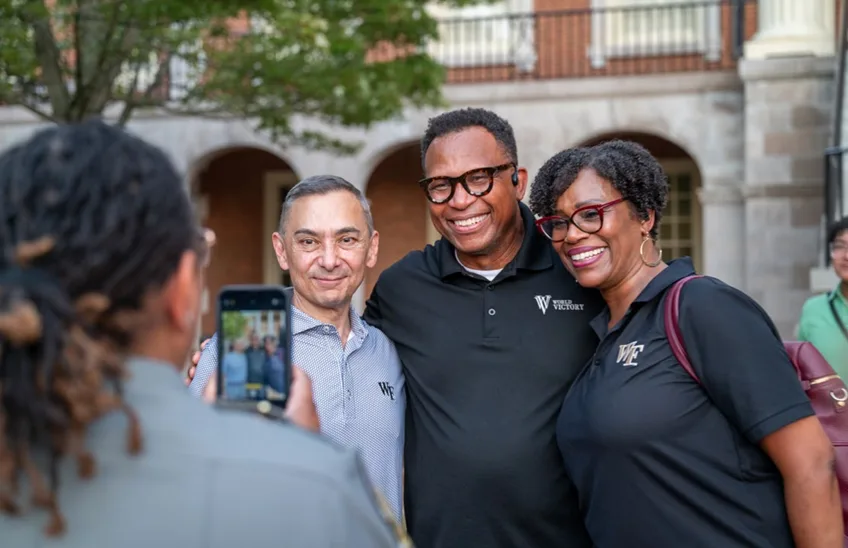
But his passion for developing human potential won out, and he chose academia. Not long after, Enron collapsed.
“A year and a half later, I saw one of my former colleagues testifying on C-SPAN,” Rodriguez recalls.
The moment cemented a key component of his leadership philosophy: Organizations must be anchored in values, integrity and humanity, not just short-term optimization.
He instilled that philosophy at Rice University’s Jones Graduate School of Business, where he was dean for a decade. Known there as a builder, he expanded the faculty, launched a top-tier online MBA program and dramatically amplified the school’s national footprint — all while preserving an accessible, student-first culture.
The transition from faculty member to administrator felt natural for Rodriguez. “I don’t think anybody ever learns leadership before leading,” he says. “You have to be in the moment. You try on the jacket, and if it fits, it fits. If it doesn’t, it doesn’t. For me, it really fit.”
For an economist who analyzes optimization strategies and margins, Rodriguez’s leadership style is distinctly human.
“As a leader, I tend to be analytical, but focused on the people — setting a direction, keeping focus and finding ways to get there,” Rodriguez explains. “The challenge all leaders face is that there are no hard-scripted answers for what to do. Your job is to act with the information and the team you have to get things done. I really enjoy the personal side of that — working with people to figure it out.”
You try on the jacket, and if it fits, it fits. If it doesn’t, it doesn’t. For me, it really fit.”
-President Peter Rodriguez
Three virtues form the core of his approach to leadership: attentiveness, responsiveness and kindness.
“A leader’s job is to set the standards for the organization,” Rodriguez says. “What is excellence for us? A leader has to live that, exemplify it and celebrate it. First, we need to understand our students, faculty and staff better than anyone else — that’s attentiveness. Responsiveness is how we demonstrate respect and professional courtesy to everyone. And kindness is being as generous and empathetic as you can with the resources you have, even when making hard or unpopular decisions.”
The combination of academic rigor and profound personal care is what drew Rodriguez to Winston-
Salem. His own blend of corporate insight — including through his board chairmanship of a Federal Reserve Bank branch — and devotion to the human side of education made him a perfect fit for Wake Forest.
“Peter blends all of the characteristics that the Wake Forest community said were important,” says Curt Farmer (’84, MBA ’91, P ’16), chair of the University Board of Trustees and co-chair of the Presidential Search Committee. “He brings a strong academic background with great grounding and experience. He’s an entrepreneur; he thinks outside the box. He’s had good experience outside the university setting and in the business community. Stylistically, he is a very thoughtful, collaborative and relationship-oriented leader. Over and over again, the search committee heard how much people enjoy working alongside him.”
“One of my early jobs was at Wake Forest, where I observed some of the figures who formed what we now understand as the particular character of the institution — people such as Lu Leake, James Barefield, Tom Mullen, Bern Beatty, Ed Wilson, Al Martin, Katy Harriger — any of us could name dozens,” notes Jeanne Whitman Bobbitt (’79, MBA ’87), vice chair of the Board of Trustees and co-chair of the Presidential Search Committee. “They are luminous figures who shaped who and what we are. I am confident in saying that in Peter Rodriguez, we have found a worthy heir.”
Taking the helm of Wake Forest feels like a homecoming for Rodriguez. He’s arrived at a place where he can honor the values his parents taught him and the mentors who guided him. When he looks at the University’s motto, Pro Humanitate, he sees a duty that transcends the modern, transactional view of higher education.
“Every generation has the obligation to ensure that the bulk of human knowledge is passed on beautifully and augmented,” Rodriguez says. “Education is not just career-oriented; it is for the betterment of humanity in the long run. The foundations of Wake Forest are granite, and I could not be happier to build on them.”
As Rodriguez steps into this new chapter, he is joined by his wife of 32 years, Kathleen, a former elementary school teacher eager to invest herself in the campus community. They have three children: Gabriella, a social worker in Durham; Sam, an aspiring CPA in Houston; and Michael, a freshman at Trinity University in San Antonio, Texas.
Decades after sitting at a professor’s kitchen table eating grilled cheese sandwiches and chasing data, Rodriguez’s journey has brought him to a community that mirrors his own story.
The leader who can balance data and be a champion for people plans to do what he’s done from the beginning of his educational journey — research, build relationships, learn from others and work hard.
More Stories
Back to School
These four Deacs see big opportunities for Wake Forest and its new president.
The Presidents go to Washington
Deacs who ran Student Government have a powerful advantage when they land in the nation’s capital — the leadership lessons they learned at Wake Forest.