This story is part of Living Proof, a series of profiles of alumni who got to Wake Forest on scholarships and are now giving back in their professions and communities.
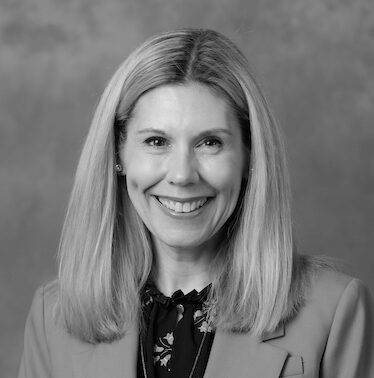
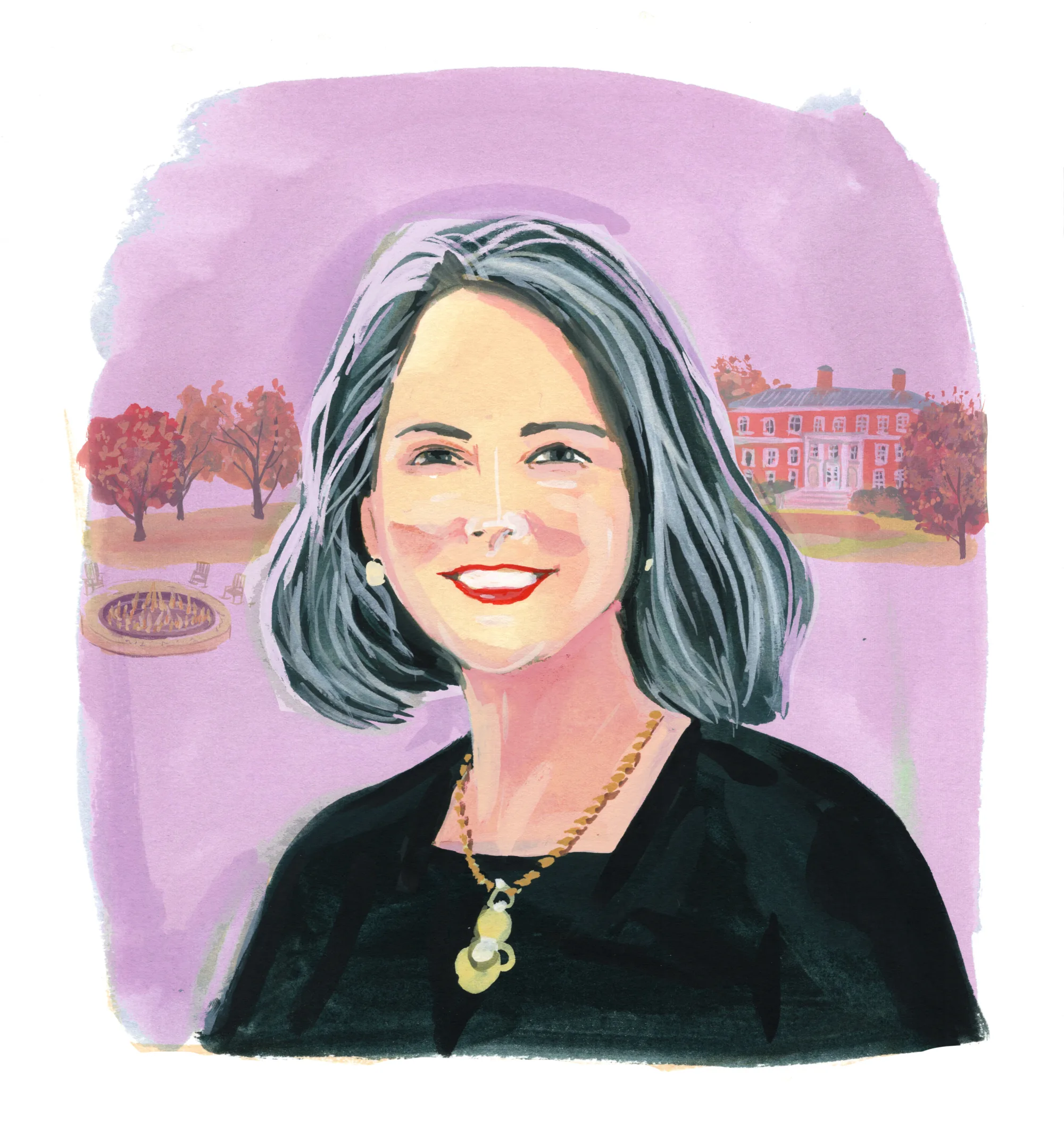
Marybeth Torbet Hays (’90, MBA ’94) is in her element in the sunny living room of Farrell Hall. She’s strategizing with Maria Sanchez (MSM ’26) about life after graduation and offering to make introductions to executives in Denver.
Sanchez is the latest recipient of Hays’s eponymous scholarship, which she funded with $1 million in 2019. The Hays Scholarship provides full tuition to a graduate business student each year with strong academic qualifications, often a first-generation college graduate. “I get to know the students, and they keep me current,” says Hays, who has more than 25 years of experience in corporate management, board service and consulting in global retail, healthcare and consumer goods. She is also a Wake Forest Trustee and a member of the School of Business Board of Visitors. In May, at the School of Business graduate student hooding ceremony, she received an honorary Doctor of Business Administration degree.
Most Hays scholars have enrolled in the Master of Science in Management, a one-year program designed for students with undergraduate degrees in other fields to gain foundational business education.
Hays is coaching Sanchez on balancing preparation for her future career with a host of other priorities: a full-time courseload, working the third shift at a distribution center to send money to her family in Denver, and also helping to lead business school events.
That juggle is a challenge that Hays knows all too well. In 1986, the Charlotte native yearned to come to Wake Forest, but her parents could pay for UNC-Chapel Hill and no more. Hays chose Wake Forest anyway, and she was awarded a George Foster Hankins Scholarship, designated for North Carolina students who have “great aspirations without financial ability.”
“After my parents, Wake Forest has been the single most formative influence in my life,” Hays says, noting that she is the first woman in her immediate family to go to college. When her father went to NC State University, his twin sister stayed home.
Hays threw herself into sociology, women’s studies and campus life. She was student chair of Parents Weekend and Orientation. She helped start the Volunteer Service Corps, including the first Project Pumpkin in 1989. She not only belonged to Thymes Society but was also president of Inter-Society
Council, the precursor to the National Panhellenic Conference. And she played the string bass in the University Symphony Orchestra. Hays envisioned a future as a professor researching criminology.
She also took out loans and worked in University Advancement, often writing thank-you notes to donors, and as a mother’s helper for a family she moved in with after graduating in three and a half years. “I couldn’t afford another semester,” she says.
Hays quickly found a job as an administrative assistant and discovered she loved working in an office. “This business thing might be what I want to do,” she remembers thinking.
So, she came back to Wake Forest to earn an MBA, receiving a scholarship named for Charles H. Babcock, who with his wife Mary Reynolds Babcock gave the 350 acres to move the University from Wake Forest to Winston-Salem. Hays also worked as a residence hall director, which provided a place to live and a small food allowance.
Business school provided her with the exposure she was seeking: “I was sitting in a presentation by an alum who worked for Kraft, and I heard what brand management was — and it was like a light bulb went off,” she says. “Then I turned to retail and merchandising, which is close to doing the same thing, working with customers and product.”
Even with the scholarships she earned, Hays left Wake Forest with significant debt from both degrees. She quickly paid it off while climbing through the ranks of several corporate household names. Hanesbrands Inc., her first employer after business school, paid her more than three times what she had made as an administrative assistant. In 2019, she completed her full-time corporate career at Walmart Inc. as executive vice president of two business lines overseeing 63,000 employees and $85 billion in revenue.
She had planned to make a significant gift to Wake Forest from her deferred compensation plan at some point later in life. But when she left Walmart, she received a payout sooner than expected, spurring her to create a scholarship right away, allowing her to develop relationships with the students who received it.
“It wasn’t a windfall. It was hard-earned money,” she says. “But I got it at a different time than I expected to. So, this was math of the heart.”
As she shared in a 2024 speech at the School of Business: “My dream was to fund a series of scholars, mentor them and connect them with each other, in a chain reaching far into the future — first as a peer group and later as a powerful network of business Deacs. My promise to them is that as long as I am able, they will have one more person in their corner. And after I am not able, they will have each other. My amazing husband, Rick, joins me in mentoring these scholars, gamely pulling back the curtain on the self-described ‘old white guy executive’ culture.”
So far, seven women have received the scholarship. They are building careers in data analytics, product management, consulting and accounting. Hays gathers them through group texts and emails at the beginning of each academic year to welcome the newest scholar and share insights, favorite professors and articles.
She also occasionally hosts them at her Winston-Salem home — the same house where she once worked as a mother’s helper. She has stayed close to the family that sheltered her as a student and young graduate, so when the parents decided to move into a retirement community at the same time she was returning from Arkansas, it felt right to buy the house, she says.
The Hays Scholarship made the MSM program possible for Mikalia Jackson (MSM ’23), a business strategy consultant with Deloitte in Boston. Her father had died unexpectedly shortly after she graduated from Spelman College, changing her family’s financial situation.
“When I met Marybeth, it just felt like I was talking to a family friend. She’s so personable and honest and open,” Jackson says. “I got advice on what to do for the first week of classes, to treat your job search like another class — it helped me along the way. … And I hope I can contribute to her scholarship fund in the future.”
Read more about our alumni scholars:
The architect who came home
Robert Cox (’09)
The small-town dentist
Bryson Rominger (’15)
The debater turned lawyer
Alex White (’22)
More Stories
Fit? Check.
President Peter Rodriguez has landed at a university that is “congruent” with his background and his values.
Shining a light on Wake Women
Wake Forest is not a single story. It is the sum of every individual experience of those who have passed through this institution.
Back to School
These four Deacs see big opportunities for Wake Forest and its new president.