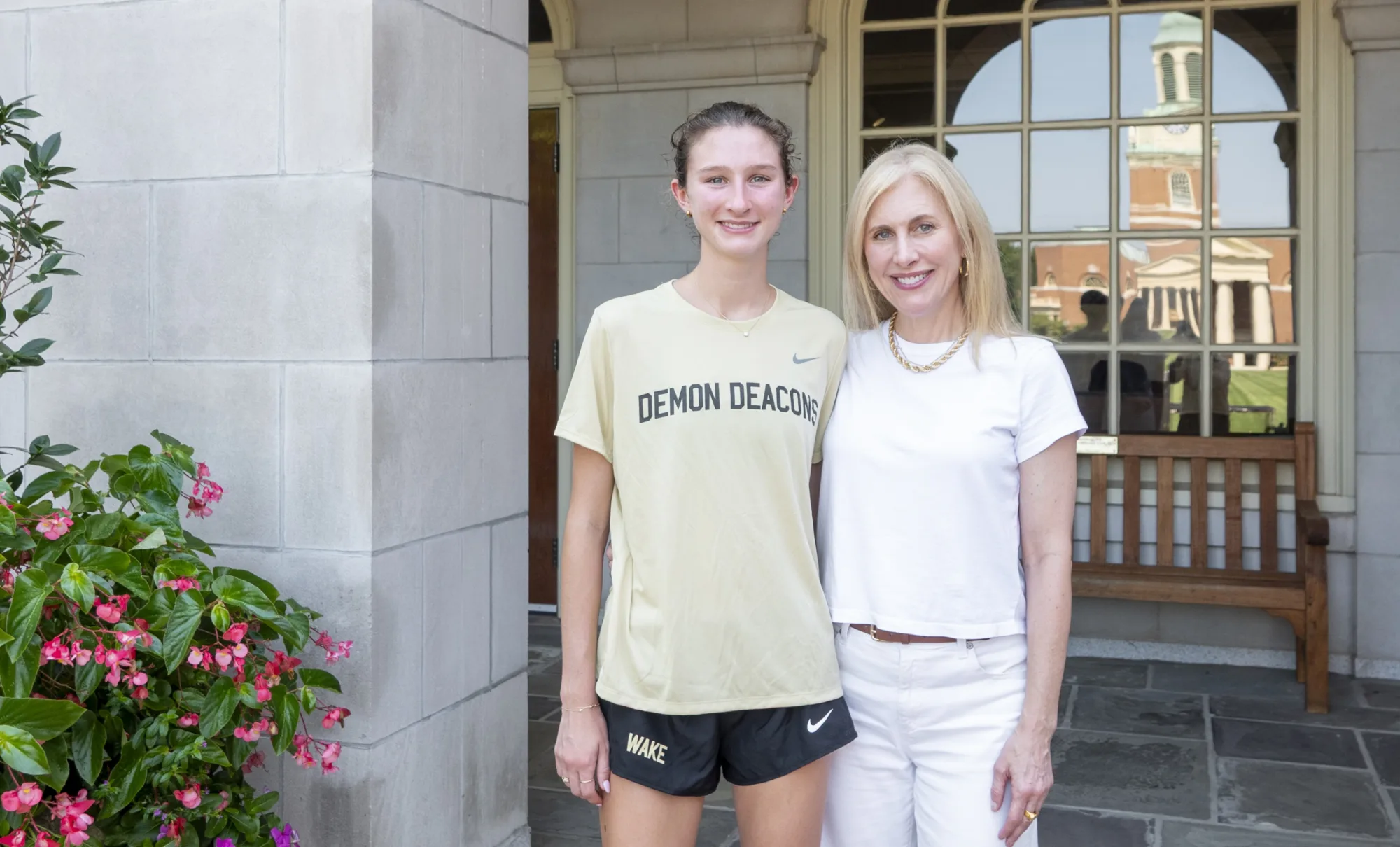
There are busy summers, and then there are summers like Emily Giffin (’94, P ’30) had this year.
Her youngest child graduated high school in May, and her twin sons graduated from Columbia University the same month. Her 13th novel, “Love You More,” was published in early July, followed by a multi-city book tour. While on tour, she was preparing to help her sons move to two different cities for graduate school.
The hectic season culminated in August with the biggest milestone of all: Arriving back at Wake Forest, where her daughter, Harriet Blaha (’30), is beginning her first year. Helping Harriet settle into the same dorm where Giffin lived for two years was a “pretty special and surreal experience,” she says.
“Of course, it was difficult to leave her, but I love knowing she’s beginning this next chapter in a place that means so much to me,” Giffin says. “Wake Forest shaped the person I’ve become, and I’m incredibly excited to watch Harriet make the place her own.”
After Giffin returned home to Atlanta, I asked her to reflect on the whirlwind summer and coming back to Wake Forest in a new capacity.

NATALIE JENNINGS: I could not put down “Love You More.” Without spoiling it, Billie, the main character, is thrust back into her hometown many years after she left it for a big city and big career. It occurred to me that you are diving back into this place after building a big life beyond Wake Forest. Was this transition on your mind as you were writing the book?
EMILY GIFFIN: Although the main characters in the book went to the University of Wisconsin rather than Wake Forest, I thought a lot about how instrumental college is in forging our identities. Billie built a very successful life in New York, but going home forced her to look at the choices she’d made and ask herself a pretty fundamental question: What still matters to me?
I think returning to Wake at this stage of my life raises some of those same questions. There’s something powerful about revisiting a place you knew at eighteen and discovering what still resonates with you — and what you now see differently.
NJ: Are there other characters, storylines or scenes from your other books that were inspired by your time at Wake Forest?
EG: A lot of my books include flashbacks to college, and whenever I’m writing about that pivotal time of life, I’m inevitably drawing on my own experiences. In fact, I think there’s a little Wake Forest nugget or shout-out in almost every book I’ve written.
The one that stands out most is “The One & Only,” which centers around a college football program in Texas. Even though the fictional setting is far from Winston-Salem, I worked in the names of former Wake players and other friends throughout the book. It was my way of bringing a little bit of Wake into that world—and a fun Easter egg for anyone who happened to recognize the names.
NJ: What are you most looking forward to as your daughter starts at Wake? Are there any parts of your Wake Forest journey you hope she will experience or avoid?
EG: Harriet is running cross-country and track at Wake, so I know she’ll develop close relationships with her teammates and coaches, but I hope she gets to know her professors, too. I’m most excited for her to discover things she doesn’t even know she’s interested in yet and to take some intellectual risks. One of the great gifts of a liberal arts education is that you arrive thinking you know yourself pretty well, and then a class, a conversation, a friend or an experience opens a door you didn’t even know was there.
As for what I hope she avoids? Probably some of my fashion choices!
NJ: How do you think Wake has changed since you were a student?
EG: It has obviously grown tremendously since the ’90s. It feels like a much bigger and more ambitious institution than the Wake I attended — the facilities, the programs, the opportunities available to students and the university’s reach and reputation have all expanded tremendously. I’m very excited for the arrival of President Rodriguez and look forward to seeing what he does in the years ahead.
But what makes me happiest is how much of the core still feels familiar. Wake still seems to place enormous value on relationships, and there’s still this deep-seated belief that success is about more than collecting credentials or landing a great job. So much has changed, but the things that made Wake feel like Wake to me are still there.
NJ: Walk us through what you would do on your best day at Wake Forest as a student, and if you know it yet, as a parent.
EG: I spent my four years as the men’s basketball manager for Coach Dave Odom. Rodney Rogers (’94, LHD ’22), Randolph Childress (’94, P ’20), Marc Blucas (’94), Trelonnie Owens (’95) and Stan King (’94), were all part of my incoming class, so it was a very magical time for Wake hoops. Being part of that team experience gave me some of the greatest friendships and memories of my life. The energy of home games was always amazing, but I also loved the routine of practices — sweeping the hardwood floors of the old gymnasium before the players arrived, rebounding free throws to close out practice and spending time with Roxann Moody (’82) in the equipment room. Roxann is still in charge today, and her office is always my first stop when I visit campus!
Other great memories include talking with my professors during office hours and studying in a quiet, tucked-away corner of the stacks in Z. Smith Reynolds Library. I loved the silence, the smell of the old books and the feeling of having found a little world of my own. Most of all, I cherish the simple moments with friends, whether eating in the Pit, strolling through Reynolda Gardens or studying in the Benson Center.
As a parent, I want to be there for whatever Harriet wants to share with me. I want to see the places she loves, meet the people who matter to her and experience this next chapter alongside her.
NJ: Can you leave us with some advice?
EG: For the students, I’d say: Don’t arrive with too rigid an idea of who you’re supposed to become. Take the class that has nothing to do with your major. Talk to the professor whose office hours you’re intimidated to attend. Make friends with people who grew up differently than you did. Try something you might fail at. Some of the most important parts of your college experience will be the things you never could have planned.
I hope Harriet and her classmates leave Wake not only knowing more, but knowing themselves better. One of the things I appreciate most now is that Wake has always been interested in more than what you’re going to do with your life. There’s also this idea of who you’re going to be and what you’re going to do with the opportunities you’ve been given. To me, that’s really the heart of Pro Humanitate.
More Stories

Your character biography exercise
The following exercise is adapted from a workbook used in the Program for Leadership and Character 's seminars and workshops.
Leadership in character
The Program for Leadership and Character has expanded into a campuswide movement rooted in Pro Humanitate — and become part of the Wake Forest experience.

A tradition reimagined
Wake Forest’s Program for Leadership and Character is a powerful example of what can happen when tradition and innovation come together in the hands of a creative leader.