This story is part of America From the Forest, Wake Forest Magazine’s series marking America’s 250th anniversary.
Publishing in the 21st century is a nearly frictionless endeavor. Many of us, with varying degrees of success, write and disseminate our ideas with no oversight or restriction beyond the occasional character limit.
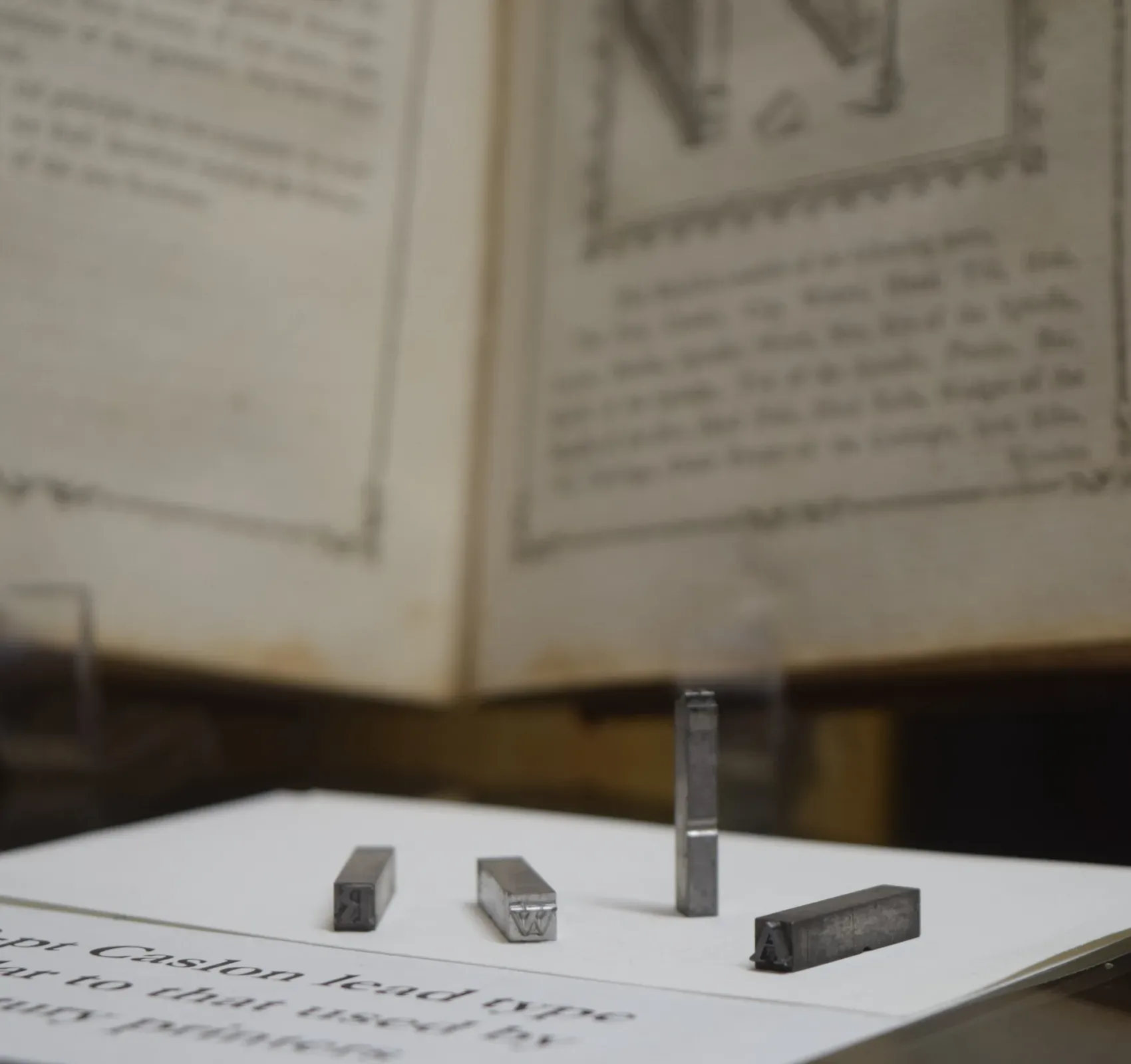
It was a very different story in the 18th century. To mass-produce a written work then, an author would first need to locate a print shop with a printing press. There, half a dozen workers would painstakingly set tiny lead-alloy letters onto the press to create a mirrored duplicate of the author’s words. Printers would apply ink to the type and then squish the sticky letters into the paper’s surface, creating a replica before the next page would be set and pressed a few hundred more times.
A prospective reader would need a shilling for a pamphlet, and an even rarer luxury: time to read it.
But the early success of the American experiment is owed in large part to those who overcame all those obstacles to publicizing their ideas. The history of the American Revolution “is inseparable from the history of print culture in 18th-century America and Europe,” says Z. Smith Reynolds library archivist Megan Mulder (P ’20). Before battles were staged and fought, the ideas that fueled them came on paper, circulating in newspapers, magazines, books and pamphlets.
Mulder and her team have collected the very best examples from Wake Forest’s Revolutionary War-era publications in a new exhibit at the Z. Smith Reynolds Library Special Collections & Archives, “Reading the Revolution: Print Culture in 18th Century America.”
One of those pamphlets is John Dickinson’s “Letters from a Farmer in Pennsylvania, to the Inhabitants of the British Colonies.” The archives’ first-collection edition was printed in 1768.
Dickinson wrote 12 essays opposing the Townshend Acts, a series of British parliamentary laws designed to raise revenue, crack down on smuggling and assert political authority over the American colonies. They were first published in November 1767 in the Pennsylvania Chronicle newspaper, and over the next two months they were reprinted in 18 other newspapers.
According to Mulder, “the spread of information, while not instantaneous, happened surprisingly quickly. … Dickinson’s letters had the widest circulation of any polemical essays in North America until the appearance of Thomas Paine’s ‘Common Sense’ in 1776.”
As tensions rose in the colonies, not every colonist wanted freedom from England. Thomas Bradbury Chandler of New York was a Yale-educated Anglican clergyman who argued the Loyalist side in the mid-1770s in his pamphlet titled “A Friendly Address to All Reasonable Americans on the Subject of Our Political Confusions: In Which the Necessary Consequences of Violently Opposing the King’s Troops, and of a General Non-Importation Are Fairly Stated.”
Chandler writes, “O my infatuated Countrymen! My deluded Fellow-Subjects, and Fellow Christians! Open your eyes, I entreat you; awake from your dreams, and regard your own safety!”
For Chandler, the stability of British rule was a safer alternative to political and economic chaos. While not the preferred story in the Revolutionary narrative, after the war, Chandler’s warnings of economic turmoil were proven true.
“I personally find seeing ourselves reflected in the past to be a bit comforting,” said Mulder. “Because there is this narrative of ‘This is the worst historical or economic period in all of history’ — Oh, no, no. Things have been much worse.
“(The colonists) were cut loose from Britain. There was no economy. That was a reality for a lot of people. It wasn’t like, ‘Oh, we’re free now, we can just go off and light our fireworks.’ We had crazy inflation, no jobs; people were starving.
“The reality is always a lot messier. I think that fact is just useful for people to understand at the time. People are always going to disagree and history is always going to be messy.”
Mess and misinformation in the 18th century
It seems like it is getting harder to pick apart truth from misinformation. But historians and archivists know that sharing false information has always been a staple of human publication.
While the title of Mason Locke Weems’ biography, “The Life of Washington, with Curious Anecdotes, Equally Honourable to Himself, and Exemplary to His Young Countrymen” may not be familiar, its contents surely are.
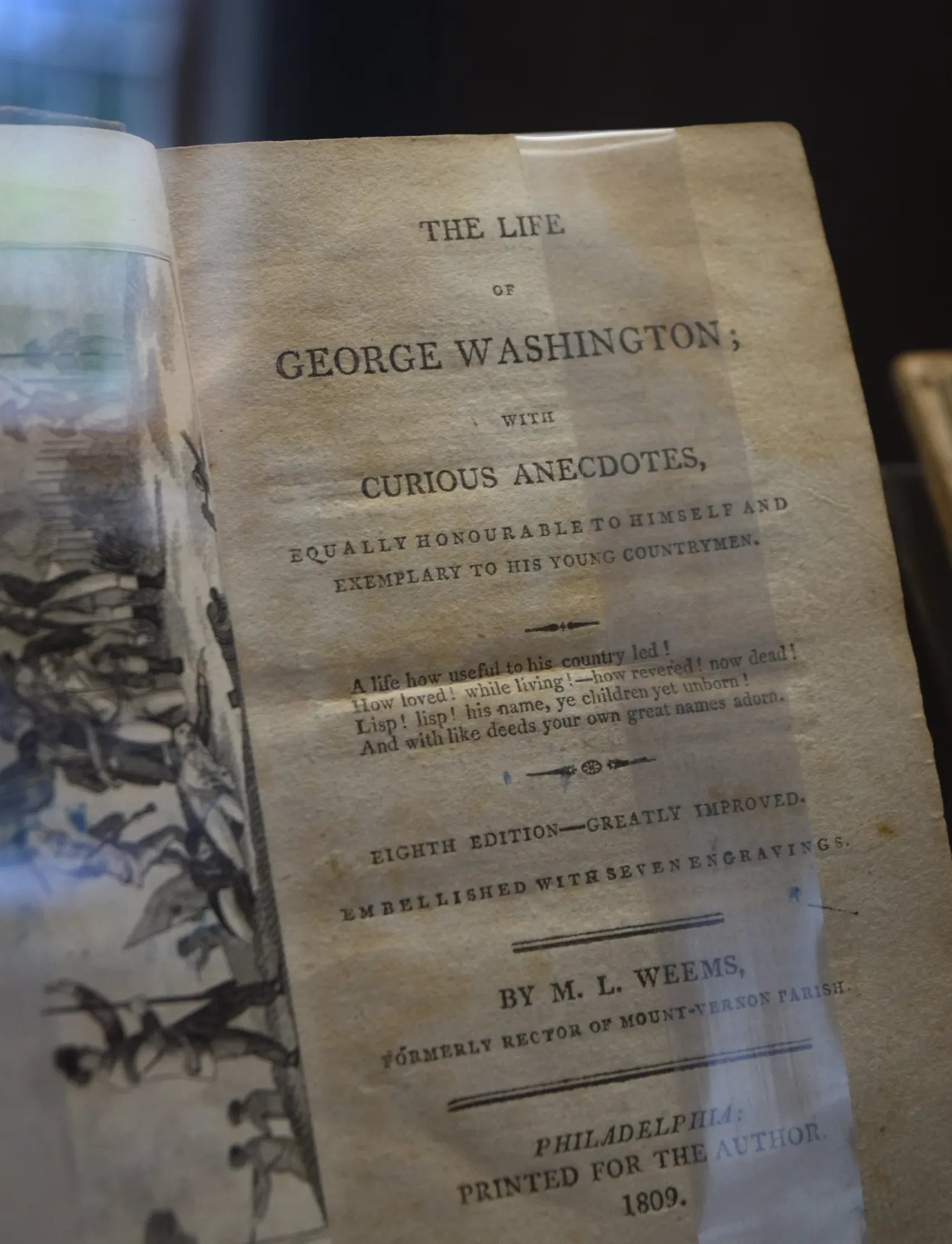
Weems’ biography of George Washington in 1800 was the first of its kind. His account of Washington’s life is the original source of the famous cherry tree anecdote and other lore that was most certainly made up for the publication.
“Also the quote ‘Shoot when you see the whites of their eyes,’” said Mulder, referring to another common piece of unverifiable lore.
“So a lot of these legends about George Washington that are not true, this book is the source for them. But it’s this great little book. It’s very cheap, it’s small. The illustrations are kind of crude, but this is what the average person was reading.”
Mulder explained that most of the books on display would have been very expensive and not read by anyone in the working class.
“But this one, Weems is one example of something that would have been owned by a more average person at the time and would have been read. I always like to see these things that maybe don’t often get saved and put into collections because they weren’t fancy, but it’s more representative of what most people were experiencing of books and print culture.”
Weems was not the only one to create fanciful narratives of the Revolution.
A South Carolina resident, Eliza Yonge Wilkinson described in letters her experience of the war as a wealthy young woman in Charleston. Her letters exclusively circulated among friends and family until her correspondence was published in 1839 by her grandson’s mother-in-law, Caroline Gilman.
The collection of letters titled “Letters of Eliza Wilkinson, During the Invasion and Possession of Charlestown, S.C., by the British in the Revolutionary War” was heavily edited by Gilman, who reordered the letters, censored some of Wilkinson’s language, updated the spelling and grammar and even fabricated entire passages.
“People have always written stuff that was completely untrue, and there have always been people that believed it,” said Mulder. “They just did it in different forms. The internet has made people believe that back in the day people always wrote the truth. That just wasn’t the case.”
The history of the Revolution is also complex. New voices in societal discourse sprang forward and new understandings sprouted. One of the clearest examples of that in the archive is the copy of “Poems on Various Subjects, Religious and Moral,” by Phillis Wheatley.
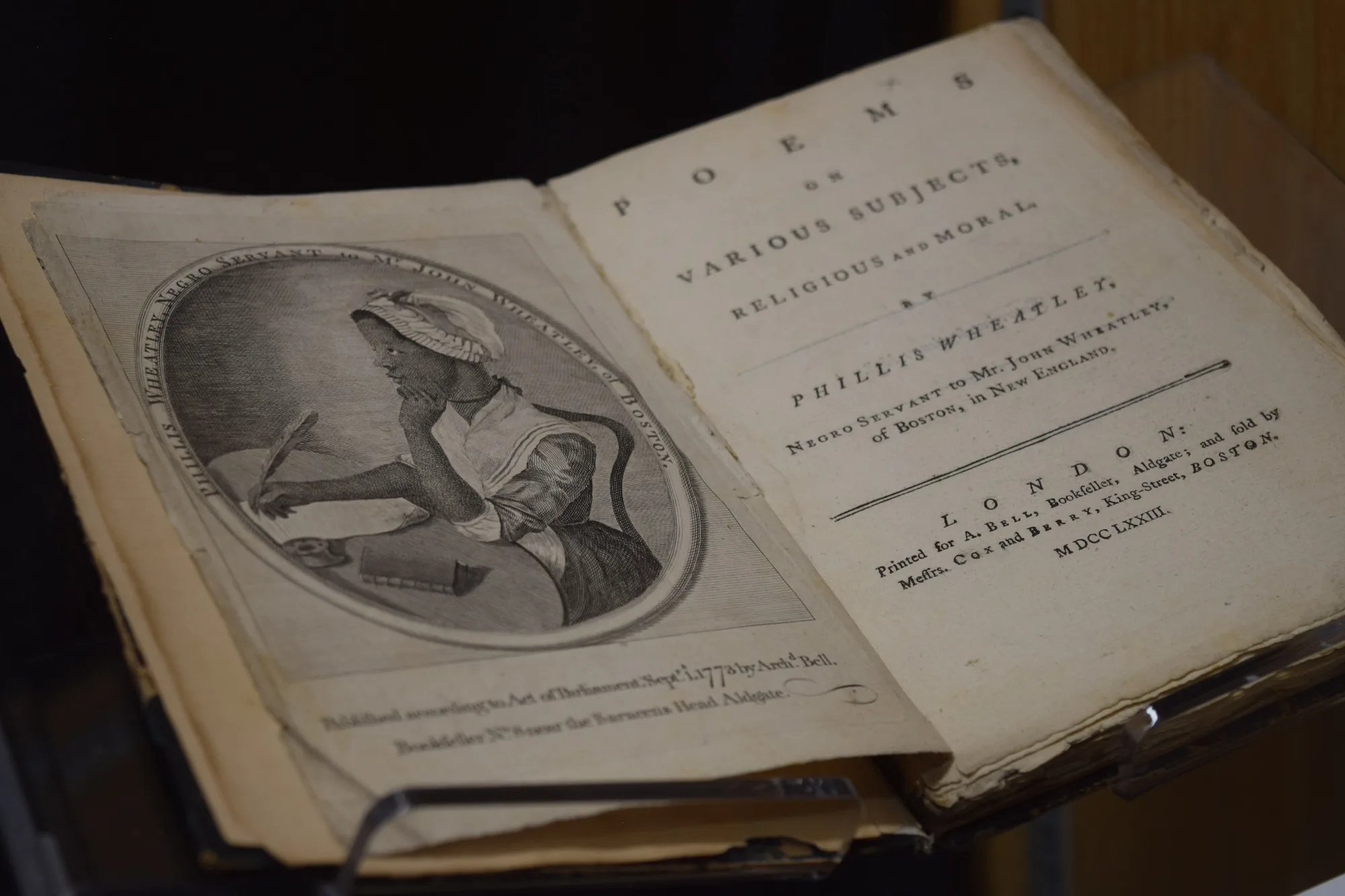
Wheatley was born in Africa around 1753. She was kidnapped as a child and survived the middle passage on a slave ship. She landed in Boston in 1761 and was purchased by John and Susanna Wheatley. While she was enslaved by the family, Susanna educated her. By age twelve, Phillis was publishing poems in the Boston newspapers.
In the early 1770s, Phillis Wheatley understood the importance of her work and began negotiations with a Boston publisher to print a collection of her poems. It was then that she came to the attention of the nascent abolitionist movement in England.
While Phillis did not find a publisher in America, a trip to London with John and Susanna’s son, Nathaniel, allowed her to broaden her search. She successfully found one there, and her book of poetry was circulated not only in England but also in the American colonies. She was freed around the same time the book was published.
“One of the things, obviously, that is a major issue is talking about slavery,” said Mulder.
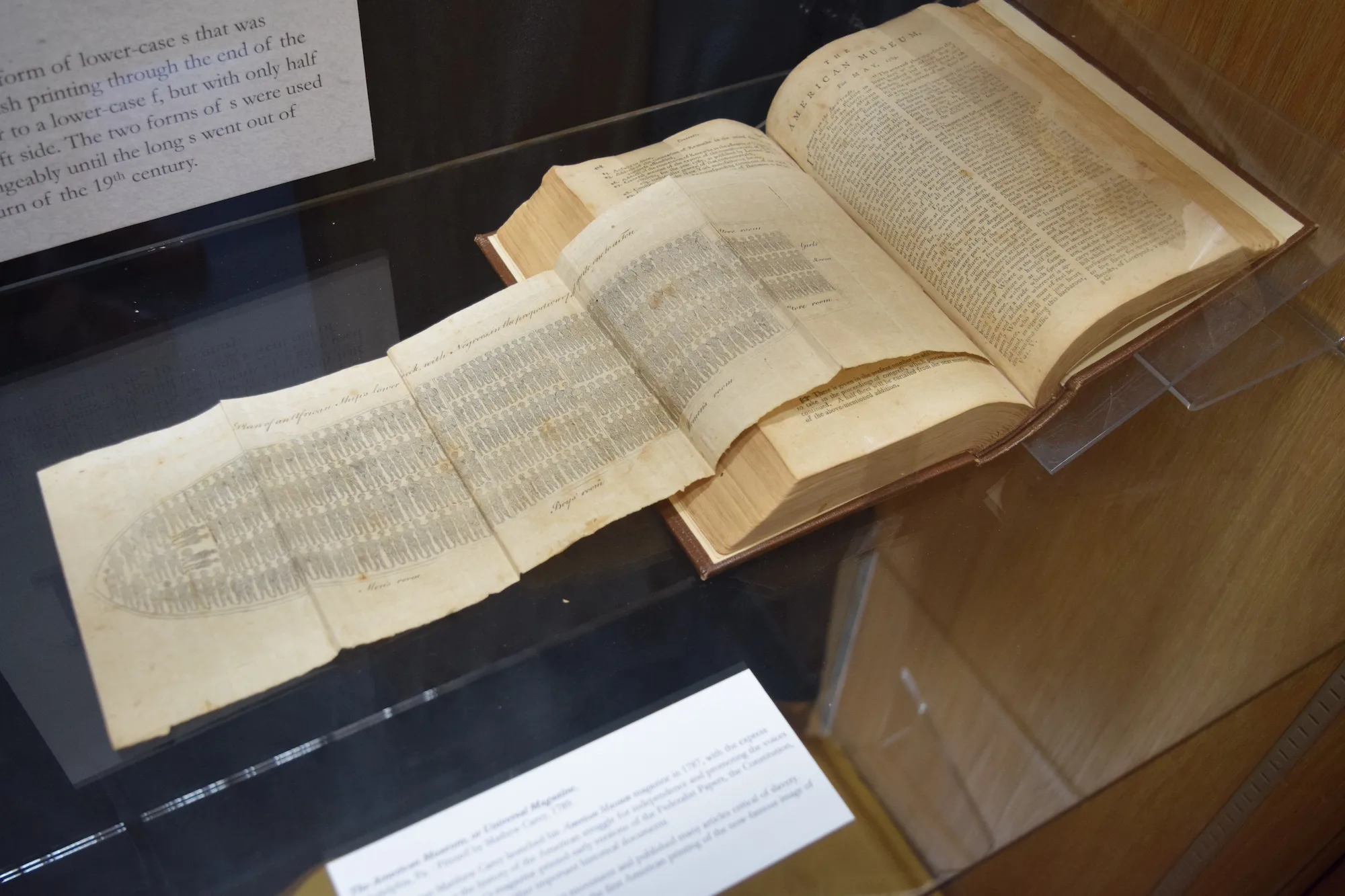
One of the earliest magazines on display in the archives functioned as a news magazine. Mulder opened it to a fold-out diagram of a slave ship.
The drawing, which was used by abolitionists to show the horrors of slavery, depicts silhouettes of people shoulder to shoulder and head to foot laid out in a ship-shaped confinement.
“That’s actually the first time that that was ever printed in the Americas from a British abolitionist publication. It drives home how slavery was already an issue. It wasn’t that people weren’t aware of it, they were just ignoring it.”
A century and a half later, some questions of the postrevolutionary period aren’t fully resolved.
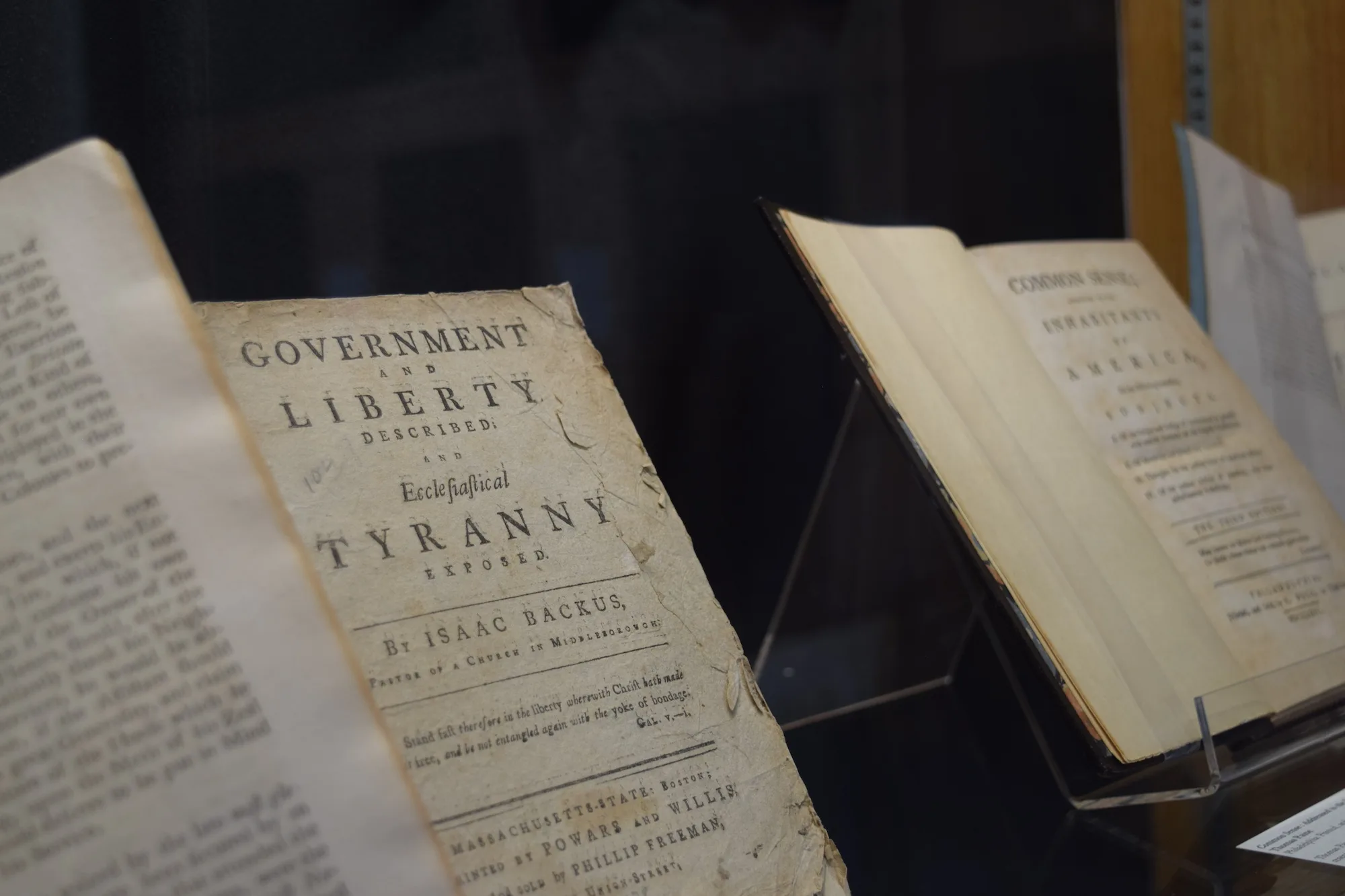
Reading Rev. Isaac Backus shows that religious freedom was still a divisive issue even after the war. Backus was pastor of a Baptist church in Middleborough, MA, and was an outspoken proponent of strict separation of church and state.
In his pamphlet “Government and Liberty Described: And Ecclesiastical Tyranny Exposed,” Backus and fellow Baptists supported American independence in large part because it seemed the best route to a true abolition of state-sponsored religion.
New authors clamored to solidify themselves and their war heroes in the written word.
Mercy Otis Warren penned “History of the Rise, Progress, and Termination of the American Revolution,”a three-volume history of the war, when she was well into her 70s.
She used both research and personal experience, leaning on her father’s background as a lawyer and early proponent of American independence. While raising five sons, she published political poems, pamphlets and satirical plays. Without overlooking the accomplishments of the Revolution and the founding fathers, she also freely criticized policies and decisions that she found lacking.
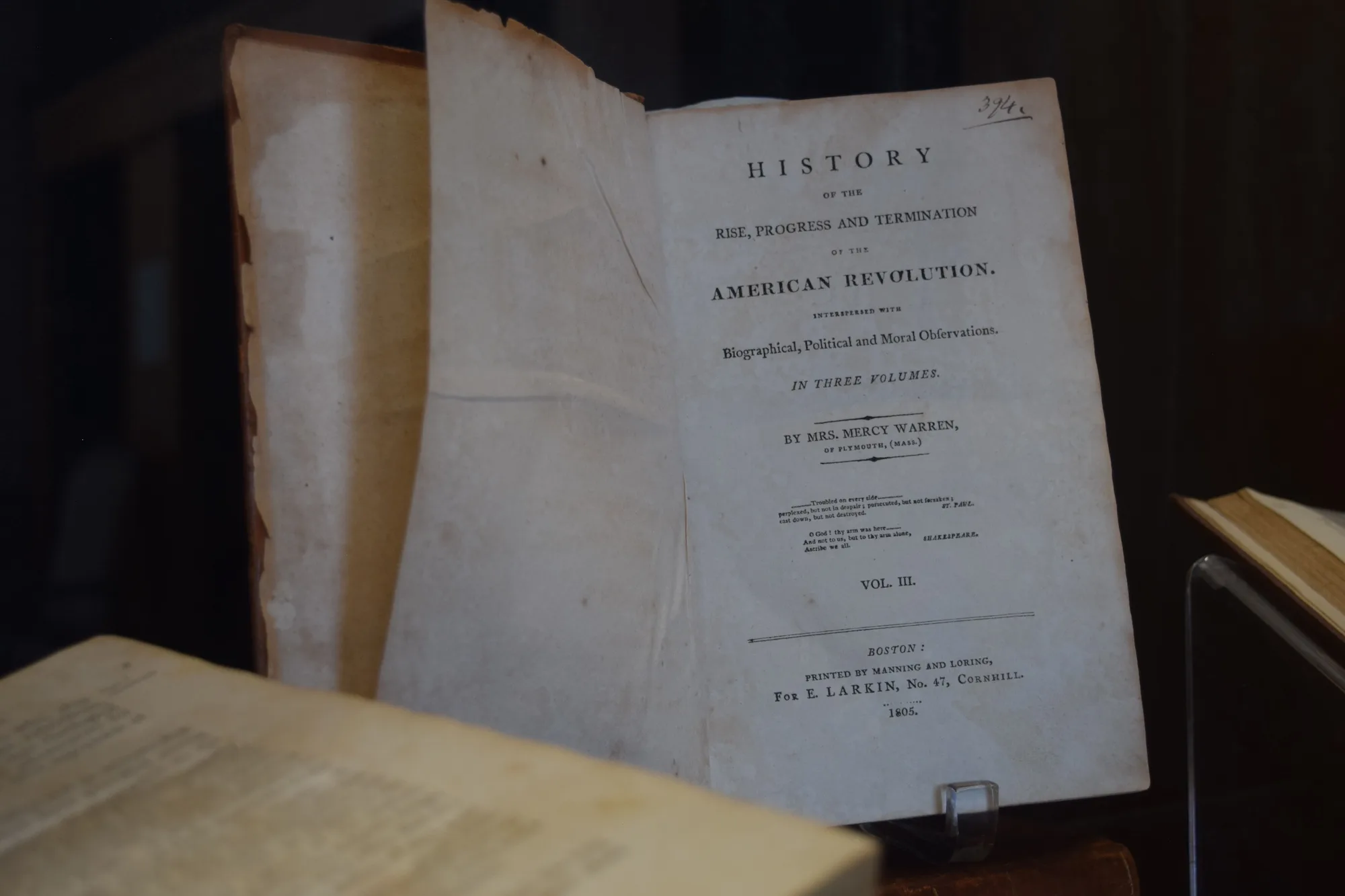
“Warren’s writings always expressed firm and well-informed opinions, and her ‘History’ is no exception,” writes Mulder.
Every primary source on display in the Wake Forest Archives, from maps to magazines, adds to the understanding of the country’s founding, often holding up a mirror.
“I think for this exhibit, I just want people to come and experience what it was like to be living in North America in that time period, what you would have been reading and what things would have looked like to you, and how information would have been communicated,” said Mulder.
The exhibit “Reading the Revolution: Print Culture in 18th Century America” is set to be displayed until Dec. 31. The Z. Smith Reynolds Library Special Collections & Archives are open Monday to Friday from 10 a.m. until 4 p.m. or by appointment. The Special Collections and Archives are located in ZSR Library room 625.
More stories like this one
Maya Angelou
Reynolds Professor of American Studies (April 4, 1928 — May 28, 2014).
A Century of Female Voters
Wake Forest alumna helps launch a newsroom named for the 19th Amendment, which gave U.S. women voting rights in 1920.
One For the Books
Ann Julian Abadie (’60), whose career has focused on Southern culture, will be honored at the annual Oxford Conference for the Book.