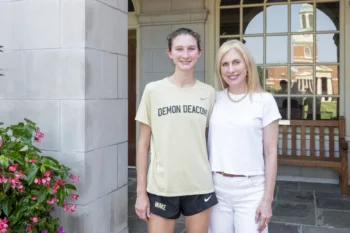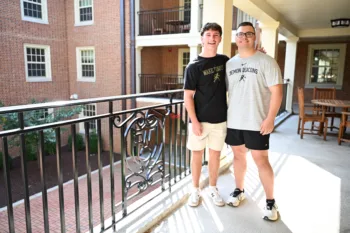
Last September, Wake Forest made a life-changing promise: free tuition for North Carolina students whose families make less than $200,000 a year and have typical assets.
An avalanche of response followed. Proud alumni praised their alma mater through email and social media, enthusiastically spreading the news to high school students in their orbits. Applications from North Carolinians soared more than 75% from the previous year.
The initiative is momentous, but the spirit behind it is nothing new to Wake Forest. Paving the way and paying it forward are among the University’s longest running traditions.
Back in 1834, the very first Wake Forest students worked up to three hours a day in exchange for a tuition credit. While technically not a scholarship, this early “work-study” made education accessible for young men who otherwise could not afford it. For many decades, tuition was waived for ministerial students. The first Wake Forest students’ access to opportunity came at the expense of others’, with at least one early bequest including the sale of enslaved people.
Donors have created and funded more than 1,000 scholarships throughout Wake Forest’s history — and North Carolina students have disproportionately benefited. In the most recent academic year, the 16% of undergraduates who hailed from North Carolina received 32% of all scholarship dollars.
Now, the North Carolina Gateway could extend financial aid to more students in Wake Forest’s home state than ever before. The biggest beneficiaries are students from middle-income families, who often don’t have access to federal financial aid but who would have struggled to afford tuition on their own.
Expanding access to opportunity to all students has been a priority for President Susan R. Wente since her arrival in 2021. She kicked off her inauguration by announcing the For Humanity scholarship initiative. The Gateway initiative “says clearly to students and families who may not have considered Wake Forest because of cost: ‘Wake Forest is within your reach,’” Wente said.
Here are some significant moments in the history of Wake Forest scholarships:
1834: The Wake Forest Manual Labor Institute starts holding classes on land bought by the State Baptist Convention in Wake Forest, North Carolina. Students are required to perform three hours of manual labor a day to keep tuition low. Students must be at least 12 years old, male and provide their own axe, hoe, sheets and towels.
1836: John Blount, a planter in Edenton, North Carolina, dies, leaving what’s believed to be the first bequest to Wake Forest. His will provides an “endowment for the education, at Wake Forest Institute, of ‘poor and indigent young men destined for the ministry,’” according to the “History of Wake Forest College, Vol. I, 1834-1865.” Blount’s land and enslaved people are sold in 1860, after his wife’s death, to fund that endowment. Most of the proceeds are invested in Confederate bonds, rendered virtually worthless after the Civil War.
You can learn more about the enslaved people impacted by Blount’s endowment and this chapter of Wake Forest’s history here.
1875: James W. Denmark, a Civil War veteran and Wake Forest student, starts what is possibly the first college loan fund in the United States. “Mr. Denmark had come to know the need of such a fund from the difficulty he had and saw other young men having in their efforts to get an education,” G.W. Paschal wrote in “A History of Wake Forest College, Vol. II, 1865-1905.” Denmark rallies faculty, townspeople and students to make small contributions to aid needy students. The fund, an independent nonprofit, at first functions mainly as a revolving loan fund, since it has no endowment. In the 1950s, the fund’s governing documents are amended to let it lend to women attending Wake Forest — and to formally limit its purpose to making loans, not grants. When Wake Forest shifts its financial aid to grants from loans in the 2020s, the fund’s board of directors, largely made up of Wake Forest administrators, faculty and retirees, win court approval to expand its scope again. They start providing scholarship support to Wake Forest undergraduates, update the name to the James W. Denmark Loan and Scholarship Fund Inc., and, in the 2024-25 and 2025-26 academic years, grant 15 students a year scholarships totaling about $355,000.

1920s: Local families and Baptist organizations start small, dedicated funds to support students entering the ministry or those from specific North Carolina counties.
1951: Wake Forest starts hosting a U.S. Army ROTC program, which pays tuition and fees in exchange for a commitment to serve in the military after graduation.
1954: Col. George Foster Hankins (1902, LL.D. ’52) of Lexington, North Carolina, dies, leaving an estate worth $1 million (about $12.5 million in today’s dollars) to create a scholarship fund focused on students with need and merit. When President Harold W. Tribble (LL.D. ’48, P ’55) asks Hankins for a donation toward building the Winston-Salem campus, he says he would rather help educate students. In the 2025-26 academic year, 47 students receive $392,794 in Hankins grants.
1966: Guy T. Carswell (1922, LL.D. ’62), dies, leaving the University $1.3 million to create the Carswell Scholarship program. During his lifetime, the Charlotte attorney and his wife, Clara H. Carswell, already had helped many individual Wake Forest students with the cost of their education. Starting in 1968, the scholarship at first pays students’ full tuition; today, up to five Carswell Scholarships cover the full cost of attendance and summer grants.
1982: The Z. Smith Reynolds Foundation announces a $1.5 million gift to create the Reynolds Scholarship program to draw highly qualified students from across the country. Today’s qualifications for Nancy Susan Reynolds Scholars read that they “must be not only excellent students and promising scholars, but also creative leaders who are able to influence others in directions likely to benefit society. They will have achieved unusual distinction in the classroom and beyond.” Up to five incoming students each year receive the full cost of attendance and summer grants. One of the first Reynolds Scholars that fall is Rogan Kersh (’86), who goes on to become provost, from 2012 to 2022.
1983: The Board of Trustees starts a scholarship program using some of the funds received from North Carolina Baptist churches. They name it for William Louis Poteat (1877, MA 1889, P 1906), president from 1905-27. Poteat was a prominent Baptist leader and an innovative biology professor who helped defeat state legislation that would have prevented teaching evolution. The University awards at least $1,500 to one student from each of North Carolina’s 11 congressional districts. Recipients must be active members of Baptist churches in North Carolina who are likely to make “a significant contribution to church and society.” Donors go on to establish 17 other individual scholarships to supplement the Poteat Scholars program. The award now goes to up to 20 students a year. (The University made a formal break from the Baptist State Convention of North Carolina in 1986; the Poteat Scholarship remains.)
1986: The Joseph G. Gordon Scholarship is awarded for the first time, providing the full cost of attendance and summer grants for up to five students a year who show exceptional promise and achievement. The scholarship, established by the Z. Smith Reynolds Foundation, is named in honor of Dr. Joseph G. Gordon, the first Black faculty member at what is now Wake Forest University School of Medicine.
1987: Two brothers, Lewis R. Holding and Frank B. Holding (’52, LL.D. ’09), create the Robert P. Holding Scholarship to honor their father and older brother, both of whom were Wake Forest alumni. The scholarship is established for North Carolinians, especially those from the eastern part of the state, in the hopes of their return to their community to make it a better place. Robert P. Holding Sr. (1916, JD 1917, LL.D. ’57, P ’48, ’52) was a native of Wake Forest who built First-Citizens Bank & Trust Co. into a major regional financial institution. Robert P. Holding Jr. (’48, P ’91), followed in his footsteps as the bank’s chairman until his death in 1979 at age 54. Several of the patriarch’s great grandchildren are continuing the family legacy as Wake Forest alumni and are engaged with the Holding Scholarship. Led by Frank B. Holding Jr., a University trustee, the Holding family is adding contributions to their fund to support the North Carolina Gateway.
1987: The Presidential Scholarship for Distinguished Achievement is created to attract about 20 students a year with outstanding talents, such as art, dance, theater, music and debate. Major gifts, including $250,000 from the Annenberg Foundation in 2002, have supported the scholarship over time.
1990: Neighboring Graylyn Estate, now a historic hotel, establishes the Graylyn Scholarship, a merit-based award providing the full cost of attendance each year to one student demonstrating exemplary leadership and academic excellence.

2000: William “Keith” Stamey (’59), president of Stamey’s Barbecue Inc. of Greensboro, North Carolina, dies, leaving more than $7.3 million to establish a need-based scholarship for students from North Carolina and adjoining states. As of 2025-26, nearly $7.7 million has been awarded to more than 200 recipients.
2000: An anonymous donor gives $4 million to create the Wake Forest Heritage Scholars. This scholarship, based on merit and need, helps low-to-middle income students from rural areas or small towns, or first-generation college students. The scholars receive up to three-fourths of total tuition and other expenses. Among their alumni are a Rhodes Scholar and three Fulbright scholars; one-third have earned advanced degrees. In 2021, after his retirement, Peter Weigl, professor emeritus of biology, and his wife, Ann Weigl (Ph.D. ’80), reveal that they are the donors.
2009: The Magnolia Scholars program is established, in part with a gift from Dr. Steven Scott (P ’97, ’00) and Becky Scott (P ’97, ’00) to provide first-generation students financial and academic aid. The program has since helped hundreds of students. Today, at least 28 endowed funds support Magnolia Scholars.
2011: The Wake Forest Scholars program begins as part of the “Wake Will Lead” campaign. It is designed primarily to help middle-income students.
2011: Charlotte attorney, businessman and philanthropist Porter B. Byrum (JD ’42) makes a landmark donation to create the Porter B. Byrum Scholarship for undergraduates with financial need, along with athletic and law scholarships. No person has been a more generous benefactor than Byrum, whose lifetime giving to Wake Forest totaled more than $120 million. In 2011, he gives Wake Forest $40 million, the largest donation in its history, with the sale of Park Road Shopping Center in Charlotte. Upon his death in 2017 at age 96, he leaves an additional $70 million for scholarships. About 1,370 alumni have received undergraduate Byrum awards to date.
2013: The Stamps Scholarship, made possible through the generosity of E. Roe Stamps IV, his late wife Penny and matching funds from Byrum, covers the full cost of attendance, an allowance for books and personal expenses, and summer travel or study grants. Wake Forest’s Stamps Scholars join a network of about 1,000 current undergraduates round the world.
2019: As part of the University’s Program for Leadership and Character, 10 incoming first-year students are named as the first class of Leadership and Character Scholars. They receive full scholarships, leadership and character programming and service opportunities.
2021: Parents’ Council members Kevin and Delia Willsey (P ’22) make the lead gift to start the 1834 Scholars program, providing access to students who have demonstrated academic excellence and financial need. The program becomes a philanthropic priority for the Parents’ Council, with more than 20 families contributing more than $6 million to date. The program provides support for 15 students across the classes of 2027, 2028 and 2029.
2022: President Wente announces the For Humanity Scholarship initiative in her inaugural address. Funders commit more than $190 million for scholarships and student aid, specifically targeting students whose families do not qualify for Pell grants but still face significant debt.
2025: The North Carolina Gateway to Wake Forest University commits to providing free tuition to incoming undergraduates from North Carolina whose families make less than $200,000 a year. For students with family income under $100,000, financial aid will cover the cost of standard living expenses in addition to tuition. Students in families earning $200,000 to $300,000 are eligible for financial aid covering half of their tuition. Vice President for Enrollment Eric Maguire sees the initiative as a way to “allow families to see and understand their likely out-of-pocket costs from the beginning. That level of assurance and transparency will help more North Carolina families envision Wake Forest as a possibility.”
Spring 2026: Following the announcement of the North Carolina Gateway, applications from North Carolina students climb more than 75% from the previous year.
The future: Could the Gateway expand to include neighboring states, or eventually for all incoming students? If Wake Forest can hit certain fundraising targets, expansion is possible, according to Wente and Maguire.

More stories like this one
Bringing It Home
Abrea Armstrong (MSM ’16) is tapping her wide-ranging experience to build awareness and appreciation of Winston-Salem’s Black history and culture.

Women of Wake Forest: A History of their Own
A look back at the milestones along with the millstones in the story of women at the University.
Philanthropy
The show must go on! Alumni share in the applause.