This story is part of Living Proof, a series of profiles of alumni who got to Wake Forest on scholarships, and are now giving back in their professions and communities. Read more
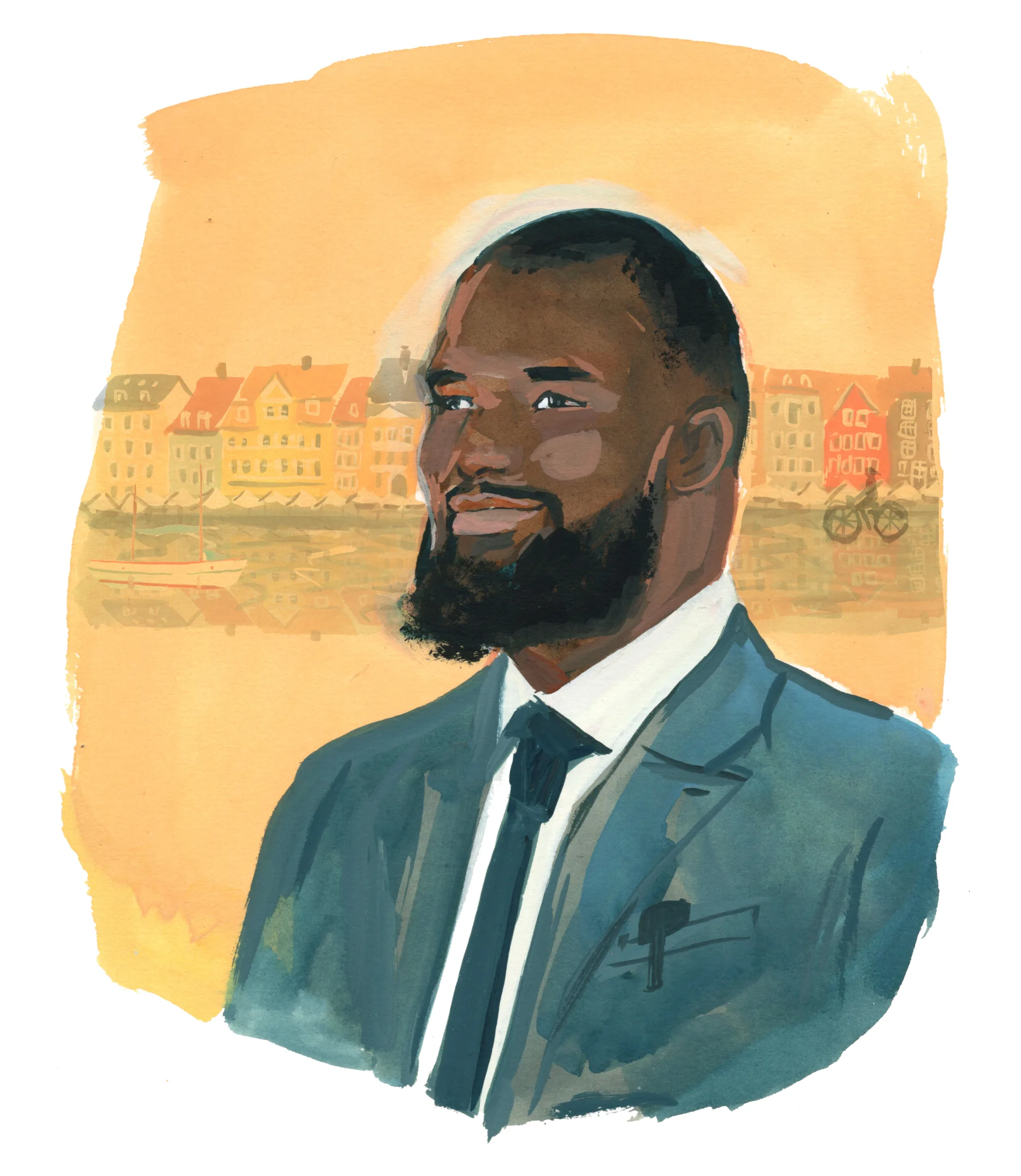
Alex White (’22) came to Wake Forest for the first time as a Greensboro, North Carolina, high school student to compete with his debate team. He was invited back for the University’s Summer Immersion Program, where he signed up for the Law Institute.
Those two experiences gave him a sense of belonging that he wanted to continue in college. “When I got my Wake acceptance, I was ecstatic, because this institution was like family for me,” he says. “And when I got the financial aid package, I realized that I was going to have access to so many opportunities because of Wake — because they saw the potential in me.” He started with a Byrum scholarship,
Instead of spending his first year on campus, White went to Copenhagen, Denmark, as one of 16 first-year students in the yearlong “Global Awakenings” program (no longer offered, though semester and summer programs in Copenhagen are available for older students). They developed long lasting friendships while traveling far and wide together in Austria, Italy and Morocco.
The next year’s start on the Reynolda campus came as a culture shock, White says, but he made the debate team, which helped him earn an additional scholarship.
White delved into “Kritik,” a type of argument that challenges the underlying worldview of the opponent. “It opened my mind to a different way of thinking,” he says. He also loved debating issues with professors in his major, politics and international affairs, and feels indebted to Associate Teaching Professor Jack Amoureux, who provided frank feedback on White’s personal statement for law school applications.
Amoureux remembers first meeting White in the hallway of the politics department, where they struck up a conversation about political theory. That led to three courses together “and a mentoring relationship that I deeply value,” Amoureux says.
White, an avid reader, once stopped by Amoureaux’s office to tell the professor that he had changed his mind about an opinion he had shared a year earlier after doing more reading and taking another class. “I was struck by how serious and enthusiastic he was about our ongoing conversations and his commitment to the belief that these ideas really matter,” Amoureux says.
In White’s revised law-school statement, he wrote that studying law was a way to honor his mother’s own unfulfilled wish to become an attorney. “She gave so much for me and continues to give so much to me to help me realize my dreams, so I talked about that,” he says.
He was accepted at UNC School of Law. He expected to go into corporate law, so he focused on transactional work in summer internships. But in year three, “I realized that I shouldn’t shy away from the skills I developed through Wake, through law school, and just do transactional law,” he says. “I wanted to be helping people, and what better way to help people than to focus on the bedrock of our society, which is the family?”
After graduating in May 2025, White joined Cape Fear Family Law in Wilmington, North Carolina. He passed the bar and, last fall, opened a branch of the firm in his hometown of Greensboro. He enjoys counseling clients through the legal process and has a passion for the technical puzzle of distributing assets, he says. “I really like the complexity behind that.”
White still feels the pull of Wake Forest, especially the Summer Immersion Program. He stayed connected to it as an undergraduate, supervising students in the debate track. And he would like to go back in the coming years to talk to participants about his new profession. His main message: “It’s a lot of work, but every single day, I’m helping people.”
Read more about our alumni scholars:
The architect who came home
Robert Cox (’09)
The family doctor
Cy Fogleman (’18) and Kandis McNeil Fogleman (’19)
The mentor
Marybeth Torbet Hays (’90, MBA ’94)
More Stories
Fit? Check.
President Peter Rodriguez has landed at a university that is “congruent” with his background and his values.
Shining a light on Wake Women
Wake Forest is not a single story. It is the sum of every individual experience of those who have passed through this institution.

Back to School
These four Deacs see big opportunities for Wake Forest and its new president.